
Bloomberg Intelligence expects the global pet industry to pass $500 billion by 2030, with food as its biggest category. Pet owners rarely switch a food once their dog or cat does well on it. The store that wins the first order can keep that customer for years.
That’s also why Google Ads gets expensive for pet stores. You bid on the same searches as Chewy, Amazon, Petco, and brands that sell direct. Many accounts then put dog food, cat litter, and chew toys in one campaign and judge all of it on first-order ROAS. The products that pay off on the third refill get cut first.
This guide shows how to run Google Ads for an online pet store or a DTC pet brand. You’ll see which campaigns to start with and how to set up Search, Shopping, and Performance Max (PMax). You’ll also learn what to fix in your product feed and how to bid for repeat orders.
So what should a pet store run on Google Ads? Start with brand Search and Shopping, add Search for high-intent product terms, and move into PMax once your feed and tracking are clean.
Why Google Ads Works for Pet Stores
Pet supplies are a good fit for Google Ads because most purchases start with a clear need. Someone searches for “grain-free puppy food 30 lb” or “low-dust cat litter” and expects to buy soon.
- Searches are specific. Pet owners search by brand, species, age, size, and flavor. That detail lets you match each search to the right product and skip casual browsers.
- Shopping ads show the price up front. Shoppers compare photos and prices before they click, so the clicks you pay for come from people who already accept your price.
- Most orders repeat. Food, treats, litter, and supplements run out on a schedule. At Chewy, Autoship customers brought in 84.6% of net sales in the second quarter of fiscal 2026.
Google Ads is only one part of pet shop marketing. For email, loyalty, and social ideas, see our pet marketing strategies.
Which Google Ads Campaigns Should a Pet Store Run?
Each campaign type covers a different step before the purchase. Most pet stores need two or three of them, not all at once.
| Campaign Type | Where Ads Show | Best For | Watch Out For |
| Search | Text ads on Google search results | Brand terms and high-intent product searches | Broad terms like “dog food” use up the budget fast |
| Standard Shopping | Product listings with photo and price on Search and the Shopping tab | Control over products, bids, and search terms | More manual work as the catalog grows |
| Performance Max | Search, Shopping, YouTube, Display, Discover, and Gmail | More reach for a clean feed and new customers | Can take credit for brand searches and returning buyers |
| Demand Gen | YouTube, Shorts, Gmail, and Discover, with products from your feed | Holiday peaks and new audiences | Needs good video and a clean feed |
A simple order works for most stores: brand Search first, Shopping next, then non-brand Search and PMax as your tracking and feed improve.
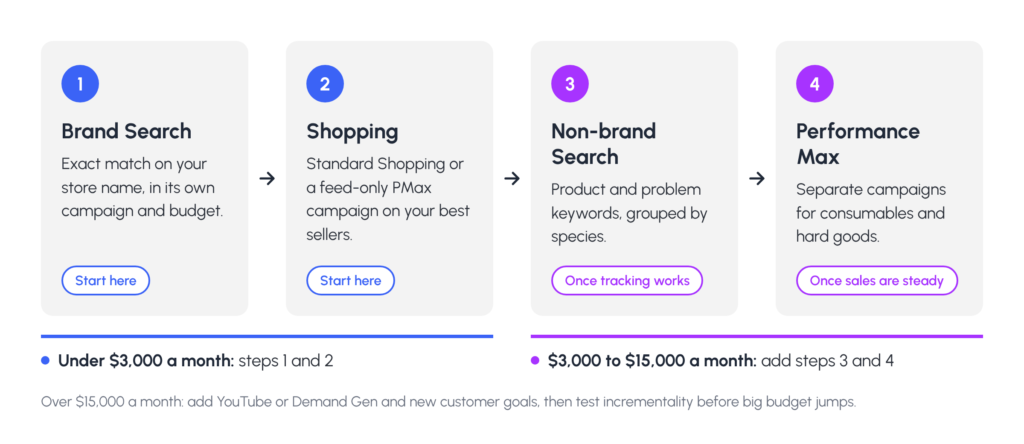
Launch order for pet store Google Ads. Start with campaigns that capture existing demand, then add reach once tracking works and sales are steady.
Search Campaigns for Pet Stores
Search ads catch people who already know what they want. Good pet store ads pay for those searches and filter out the ones that only look similar.
Group Keywords by Intent
Split keywords into groups so each one gets its own budget and bid target. Keep brand terms in a separate campaign to see what branded and non-branded keywords each bring in.
| Intent Group | Example Keywords | Match Type |
| Brand | [store name] dog food; [store name] coupon | Exact |
| Product and Attribute | grain-free puppy food 30 lb; unscented clumping cat litter | Exact and phrase |
| Brands You Stock | Purina Pro Plan sensitive skin; Blue Buffalo puppy food | Exact and phrase |
| Problem | dog food for sensitive stomach; cat hairball treats | Phrase, or broad with Smart Bidding |
Problem searches convert at a lower rate, but they bring shoppers who haven’t picked a brand yet. Send them to a page that answers the problem, not to your homepage. You can bid on the brands you stock, though brand owners can limit their trademarks in ad text.
Write Ads That Answer Pet Owner Questions
Pet owners scan an ad for the right fit for their animal, the price, and delivery terms. Put those in your headlines instead of a slogan.
- Name the species and size: “Large Breed Puppy Food in 30 lb Bags.”
- Show the offer, such as a free shipping threshold, a first-order discount, or a lower price on repeat delivery.
- Add sitelinks by species (Dog, Cat, Fish, Small Pets) and a promotion asset for sales.
- Keep health claims modest. “Supports joint health” is safer than “cures hip pain,” because Google reviews unproven claims under its misrepresentation rules.
Add Negative Keywords Early
Pet searches pull in plenty of traffic that won’t buy. Add these themes as negatives before launch, then check the search terms report every week:
- DIY and recipes: homemade dog food recipe, how to make cat toys.
- Adoption and free pets: puppies for adoption, free kittens.
- Jobs and services you don’t offer: pet store jobs, dog grooming near me.
- Local searches, since you sell only online: pet store near me, pet shop open now.
- Live animals, if you don’t sell them: puppies for sale, bearded dragon for sale.
Where AI Max Fits
AI Max for Search left beta in April 2026. It finds new search terms, writes ad text from your site, and picks landing pages. In September 2026, Google moved campaigns with automatically created assets or campaign-level broad match to AI Max. Dynamic Search Ads follow in February 2027.
For a pet store, AI Max makes the most sense in non-brand campaigns with a large catalog. Keep brand terms in their own campaign, exclude blog and policy pages from URL expansion, and review search terms before you raise the budget. Our article on how AI is changing Google Search ads covers the setup.
Google Shopping Ads for Pet Supplies
Shopping ads don’t use keywords. Google reads your Merchant Center feed and decides which searches each product fits, so the feed does the work that keywords do in Search.
Write Product Titles the Way Pet Owners Search
Put the words shoppers type at the start of the title. For pet products, a good order is brand, product, species, life stage, key attribute, and size.
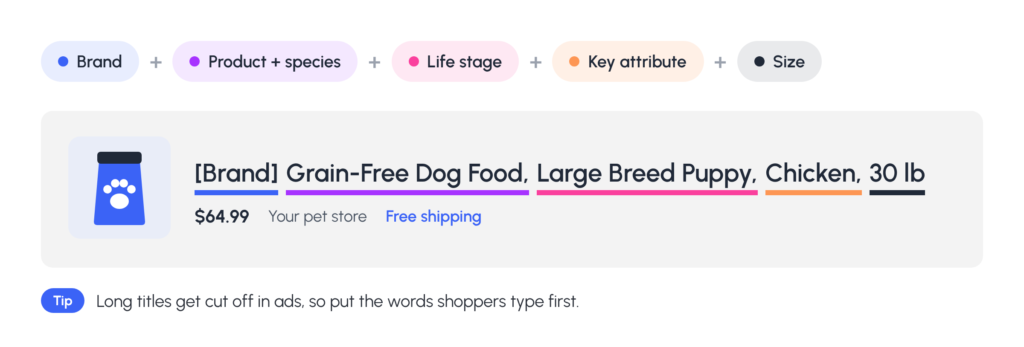
How to build a pet product title. Put the words shoppers type first: brand, product and species, life stage, key attribute, then size.
| Weak Title | Stronger Title |
| Chicken Recipe Kibble | [Brand] Grain-Free Puppy Food, Chicken, Large Breed, 30 lb |
| Unscented Litter | [Brand] Clumping Cat Litter, Unscented, Low Dust, 40 lb |
| Rope Toy | [Brand] Rope Dog Toy for Large Dogs, 3 Knots, 24 in |
A few more feed fixes matter for pet catalogs:
- Add a GTIN for every branded product, so Google can match your offer to the exact item shoppers search for.
- Group the sizes and flavors of one product with item_group_id.
- Build a product_type path by species, such as Dog > Food > Dry Food > Puppy.
- Keep price and stock in sync. Ads for sold-out food waste clicks, and price mismatches can get products disapproved.
- Use a clean main image, then add photos of real pets with the product as extra images.
Our Google Shopping feed optimization guide goes through each attribute in detail.
Use Custom Labels for Margin and Reorder Cycle
Custom labels group products by things Google can’t see in the feed, such as margin or how often people reorder. Merchant Center gives you five labels, which is enough for most pet catalogs:
- custom_label_0: species (dog, cat, fish, bird, small pets).
- custom_label_1: purchase type (consumable or hard good).
- custom_label_2: margin tier (high, medium, low).
- custom_label_3: sales status (best seller, steady, no sales).
- custom_label_4: season (flea and tick, holiday, summer).
With these labels in place, you can split budgets and ROAS targets in Standard Shopping or PMax without a feed rebuild.
Standard Shopping or PMax?
Both campaign types run on the same feed. The difference is control versus reach.
- Standard Shopping suits new accounts, small budgets, and catalogs with big margin gaps. You see search terms, set bids by product group, and control which campaign serves first.
- PMax suits stores with reliable tracking and steady sales. Google reports that advertisers who moved from Standard Shopping to PMax saw 25% more conversion value on average at a similar ROAS.
Treat that figure as Google’s average, not a promise for your store. Run a one-click experiment from your Standard Shopping campaign and compare results for four to six weeks before you switch.
Performance Max for Pet Stores
PMax runs Search, Shopping, YouTube, Display, Discover, and Gmail from one campaign. That reach helps a pet store grow, but only after you tell Google what a good sale looks like.
Split Campaigns by Margin and Purchase Cycle
Google advises fewer campaigns and a new one only when budgets or ROAS targets differ. In a pet store, they almost always differ between consumables and hard goods.
| Campaign | Products | Bid Strategy | Judge It On |
| Consumables | Food, treats, litter, supplements | Maximize conversion value with a lower ROAS target | Revenue per customer over 90 days |
| Hard Goods | Beds, crates, toys, aquariums | Maximize conversion value with a target ROAS | Profit on the first order |
| Seasonal | Flea and tick, holiday toys, summer gear | Maximize conversion value for a short run | Sales by the end of the season |
Inside each campaign, build asset groups by species. Dog owners and cat owners respond to different photos and headlines.
Give PMax Pet-Specific Assets
PMax builds ads from the images, videos, and text you upload. Plain product shots work for Shopping, but YouTube, Display, and Discover need more:
- Photos and short videos of real pets with the product, like a dog on an orthopedic bed.
- Headlines that name the species, the problem, or the offer: “Food for Sensitive Stomachs,” “Free Shipping Over $49.”
- At least one vertical video. Without one, Google may build a video from your images, and the result is usually generic.
The tips in our YouTube ad creative guide apply to PMax video too.
Control What PMax Takes Credit For
PMax likes easy conversions, such as people who already typed your store name. Google has added controls and reports that keep its results honest:
- Brand exclusions keep PMax off your brand searches, so those stay in your brand Search campaign.
- Campaign-level negative keywords and shared lists block searches you never want, like the DIY and adoption terms above.
- Search terms and channel performance reports show which queries and placements bring sales. Check them weekly in the first month.
- New customer goals need care. New Customer Value mode favors new buyers but still counts repeat sales. New Customer Only mode bids only for first-time buyers, so give it a separate budget.
Upload a Customer Match list of past buyers so Google can tell new customers from returning ones.
How to Grow Repeat Pet Supply Sales
Most pet stores earn their profit on the second, third, and tenth order. If your bidding ignores that, Google cuts the campaigns that bring your best customers.
- Set ROAS targets from customer value. Work out what a new customer earns you over 6 to 12 months after product and shipping costs. If a food buyer orders four times a year, a first-order ROAS of 2 can still be profitable. Our guide to MER vs ROAS vs CAC shows how to set the target.
- Track subscriptions as their own conversion. Record the first order and the subscription start as separate actions, so you can see which campaigns bring buyers who stay.
- Show member prices in Shopping ads. With the Merchant Center loyalty program add-on, Shopping ads and free listings can show member prices and shipping perks.
- Time remarketing to the refill cycle. Food and litter run out on a predictable schedule. Reach past buyers with Customer Match a few days before they usually reorder, and exclude active subscribers from campaigns for new customers.
Example: First Order vs. 12-Month Value
Take a store with a $70 average order and a 40% gross margin. A new food customer reorders every two months, which means six orders a year. At a first-order ROAS of 2, the store pays $35 in ads to win that customer.
| Metric | First Order | 12 Months |
| Revenue | $70 | $420 |
| Gross Profit at 40% Margin | $28 | $168 |
| Ad Cost to Win the Customer | $35 | $35 |
| Profit After Ads | -$7 | $133 |
Judged on the first order, this customer looks like a loss. Over a year, the same customer brings $133 after ad costs. Check your real reorder rate in your store platform or CRM before you lower ROAS targets, because the math only works if customers come back.
Pet Product Policies That Can Block Your Ads
Some pet products need extra approval before their ads can run. Check these before launch, since a disapproved feed can hold up a campaign for days.
- Pet medications. Shopping ads can promote pet pharmacies and pet pharmaceuticals only in the US and Canada. Merchants need LegitScript or NABP accreditation plus Google certification.
- Prescription drug keywords. In the US and Canada, you need Google certification to use prescription animal drug terms as keywords.
- Live animals. Google has safety rules on the transport of live animals and can disapprove those listings. If you sell fish, reptiles, or birds online, check the policy for your country first.
- Health claims. Supplements and treats that “cure” a condition can get flagged. Describe benefits in plain terms you can back up.
How Much Should a Pet Store Spend on Google Ads?
There’s no single right budget, but benchmarks set expectations before launch. Treat them as a starting point, then switch to your own numbers after the first month. For costs across industries, see how much Google Ads cost.
Triple Whale’s benchmarks come from Google Ads data across 21,000+ brands for August 2025 to July 2026. The CPC figure comes from WordStream’s 2026 report, which covers search ads for all kinds of pet businesses, not only stores.
| Metric | Pets & Animals | Source |
| Median ROAS | 2.88 | Triple Whale |
| Median Conversion Rate | 4.40% | Triple Whale |
| Median CPA | $25.05 | Triple Whale |
| Median Order Value | $69.08 | Triple Whale |
| Search CPC | $4.06 | WordStream |
A simple way to stage the budget:
- Under $3,000 a month: brand Search plus one Standard Shopping or feed-only PMax campaign for your best sellers.
- $3,000 to $15,000 a month: add non-brand Search by species, then split Shopping or PMax into consumables and hard goods.
- Over $15,000 a month: add YouTube or Demand Gen for new audiences, use new customer goals, and test incrementality before big budget jumps.
Pet demand also moves with the calendar. Flea and tick products climb in spring and summer, and toys and treats peak around Black Friday and the holidays. Raise budgets a week or two before those peaks, and save seasonality adjustments for short sales of a few days.
Use Demand Gen for Holiday Peaks
Video and Discover placements help when demand spikes around Black Friday and the holidays. Demand Gen runs on YouTube, Shorts, Gmail, and Discover. Link your Merchant Center feed, and viewers can buy the products they see in the video.
Petco’s agency, Ovative, used this shoppable format in a Cyber Week campaign and reported a 30% extra return boost from it.
A smaller store can copy the setup: resize your best social videos for YouTube and Shorts, connect your product feed, and launch three to four weeks before Black Friday so the campaign has time to learn. Our Black Friday marketing guide covers the rest of the holiday plan.
How to Measure Google Ads Results
Google Ads reports can look great while the store loses money. These checks keep the numbers honest:
- Track purchases with real order values. Turn on enhanced conversions and pass revenue after discounts.
- Report on profit, not revenue. A ROAS of 3 on dog food with a 15% margin loses money. The same ROAS on toys with a 50% margin makes money.
- Split new and returning customers. If most PMax sales come from returning buyers, it may get credit for orders you’d get anyway.
- Test incrementality. Pause a campaign in a few regions and compare sales with regions where it still runs. Our incrementality guide explains the method.
- Check blended results monthly. Compare total revenue with total ad spend across all channels, not only the ROAS each platform reports.
Common Google Ads Mistakes Pet Stores Make
Pet store accounts that struggle tend to share the same few problems. Check these first:
- One campaign for the whole catalog, so cheap, fast-selling food takes the budget meant for higher-margin hard goods.
- PMax that serves on brand searches and claims sales your brand Search would get anyway.
- Product titles with no species, size, or flavor.
- Food and litter judged on first-order ROAS alone.
- Ads for products that Amazon or Chewy sells for much less. The price competitiveness report in Merchant Center shows how your prices compare.
- No negative keywords for DIY, adoption, and job searches.
If several of these sound familiar, start with a structured Google Ads audit.
Frequently Asked Questions
Yes, for most of them. Pet owners search for specific products, and food and supplies sell again and again. One new customer can pay back the ad cost over many orders. Results come faster when your feed is clean, tracking works, and your prices compete with big retailers.
It depends on your products, target markets, and competition. WordStream’s 2026 data puts the search CPC for animals and pets at $4.06. Many small stores start with $1,500 to $3,000 a month on brand Search and Shopping, then raise the budget for what works.
Start with Standard Shopping if your account is new, your budget is small, or your margins vary a lot. Move to PMax once tracking is reliable and sales are steady. Test the switch with a Google Ads experiment before you move the whole budget.
Yes, with approval. Shopping ads for pet pharmacies and pet medications run only in the US and Canada. The merchant needs LegitScript or NABP accreditation plus Google certification. You also need certification to use prescription animal drug names as keywords there.
Start with your brand name, then specific product searches that include a brand, species, size, or flavor. Add problem searches like “food for sensitive stomach” next. Save broad terms such as “dog food” for later, when you have data to bid on them profitably.
New Shopping and PMax campaigns usually need two to four weeks to learn, and results settle in one to three months. Repeat orders take longer to show up, so judge food and litter campaigns on 90-day results.
Not at the start. Google reaches people who already search for products, while Meta creates demand with photos and video. Most stores begin with Google, then add Meta for new products and remarketing. See our Google Ads vs Meta Ads comparison and Meta Ads guide for pet brands.
Final Thoughts
Google Ads works best for an online pet store when the account follows how pet owners buy: specific searches, price checks, and repeat orders. Start with brand Search and Shopping, fix your feed, and bid on customer value instead of a single sale. Add PMax and AI Max once your data can support them.
After Google runs at a profit, Bing Shopping is worth a test with the same feed.
Want a second opinion on your account? Our Google Ads team can review your campaigns, feed, and tracking and show where the budget goes.