
Global digital ad spend is projected to reach $965.6 billion by 2028, according to Oberlo. With so much money allocated to digital advertising, eCommerce brands face an important question: where should you put your budget first?
Both Google Ads and Meta Ads can drive eCommerce sales, but each platform serves a different purpose. Google captures existing demand, while Meta introduces products to potential customers before they search for them.
The wrong choice can quickly drain a limited advertising budget. In this article, we’ll compare Google Ads vs Meta Ads for eCommerce and explain which platform to prioritize based on your product, goals, and stage of growth.
How Google Ads and Meta Ads Differ for eCommerce
Google Ads and Meta Ads can both bring customers to an online store, but they reach those customers in different contexts. Google often connects a product with an existing need, while Meta puts a product in front of people who may not have considered it yet.
For example, someone who searches Google for “waterproof hiking boots” already knows what they want. On Instagram, that same person might discover a hiking boot brand through a video from the brand or a creator before they decide to buy new boots.
This difference shapes almost every aspect of eCommerce advertising on the two platforms:
| Factor | Google Ads | Meta Ads |
| User Mindset | Search, research, compare, buy | Browse, watch, discover |
| Demand | Often captures existing demand | Can create and develop demand |
| Customer Intent | Often higher at the time of the ad | Varies from discovery to purchase |
| Targeting Signals | Queries, keywords, product data, audiences | Audience signals, behavior, engagement |
| Main Placements | Search, Shopping, YouTube, Discover | Facebook, Instagram, Messenger |
| Creative Role | Depends on campaign type | Central to ad performance |
| Product Data | Merchant Center product feeds | Meta product catalogs |
| Typical Ad Experience | Product appears in response to a need or relevant context | Product appears within social content |
| Search Demand Required | Important for Search and Shopping, but not all Google campaigns | Not required |
| Main eCommerce Strength | Connects demand with relevant products | Helps customers discover and consider products |
Neither model is inherently better for eCommerce. They simply start from different points in the customer journey. Google is often strongest when a customer already has a need to solve, while Meta gives brands more control over how customers first encounter and perceive a product.
This distinction affects campaign selection, creative requirements, acquisition costs, and ultimately which platform an eCommerce brand should prioritize first.
Google Ads for eCommerce: How It Works
Google Ads connects eCommerce stores with potential customers across Search, Shopping, YouTube, Gmail, and other Google properties. The platform uses signals such as search queries, product data, audience behavior, and purchase intent to determine which products and ads to show.
How Google Ads Connects Shoppers With Products
For eCommerce stores, Google Ads often starts with a product feed in Google Merchant Center. The feed provides Google with essential product information, including titles, prices, images, availability, and product URLs.
Google combines this data with customer signals to determine when and where a product may be relevant. Search campaigns add another layer of control through keywords and search queries, while automated campaign types use Google AI to select placements, audiences, and bids based on campaign goals.
Main Google Ads Campaign Types for eCommerce
| Campaign Type | How It Works | Best Use for eCommerce |
| Search | Shows text ads in response to relevant Google searches | Products with clear search demand and high intent queries |
| Shopping | Displays products with an image, price, title, and store name | Product catalogs where price and product details influence the purchase |
| Performance Max | Uses one campaign to access Google inventory across Search, Shopping, YouTube, Display, Gmail, and Maps | Stores that want automated reach across multiple Google channels |
| Demand Gen | Uses visual ads across YouTube, Discover, Gmail, and the Google Display Network | Product discovery and demand generation beyond traditional search |
This setup makes Google Ads particularly flexible for eCommerce. Brands can use Search and Shopping to respond to existing product demand, while Performance Max and Demand Gen provide access to customers across a wider range of Google properties.
The result is an advertising ecosystem where product data, customer intent, automation, and channel reach work together to move shoppers from product discovery to purchase.
Meta Ads for eCommerce: How It Works
Meta Ads helps eCommerce brands reach potential customers across Facebook, Instagram, Messenger, and the Meta Audience Network. Instead of relying primarily on active search intent, Meta uses audience signals, user behavior, ad engagement, and conversion data to identify people who may have an interest in a product.
How Meta Ads Connects Shoppers With Products
Meta combines audience data with visual creative to match products with potential customers. Brands can provide product information through a Meta catalog and connect website activity through the Meta Pixel and Conversions API. These inputs give Meta more information about products, visitors, and purchases.
Creative has a central role in this process. Images, videos, carousels, and product ads introduce the offer within the content people already consume. Meta then uses its ad delivery system to find users who are more likely to take the action that matches the campaign objective.
Main Meta Ad Formats for eCommerce
| Ad Format | How It Works | Best Use for eCommerce |
| Image Ads | Present a product or offer through a single visual | Simple products, promotions, and clear value propositions |
| Video Ads | Demonstrate the product through short or long form video | Products that benefit from demonstrations, UGC, or visual storytelling |
| Carousel Ads | Show several images or videos within one ad | Product collections, multiple features, or several items from a catalog |
| Catalog Ads | Use product catalog data to show relevant items to each customer | Stores with larger catalogs, personalized product recommendations, and remarketing |
For eCommerce brands, Meta Ads provides a way to reach customers without dependence on existing search volume. A strong combination of audience signals, conversion data, product catalogs, and creative can help brands introduce products, build demand, and bring potential customers back to complete a purchase.
Google Ads vs Meta Ads: Costs and ROI
Google Ads and Meta Ads use auction-based pricing, so neither platform has a fixed advertising cost. Actual Google Ads costs and Meta Ads costs depend on factors such as competition, audience, location, campaign objective, and ad quality. Both Google and Meta use multiple auction signals to determine ad delivery and cost.
Recent eCommerce benchmarks provide a useful starting point for comparison. According to Triple Whale’s latest reports, published in 2026 and based on full-year 2025 performance data, median CPA was $23.74 for Google Ads and $38.17 for Meta Ads. Median CPM was much closer at $12.79 for Google Ads and $13.48 for Meta Ads. The Google benchmark includes data from more than 18,000 brands, while the Meta dataset covers nearly 35,000 brands.
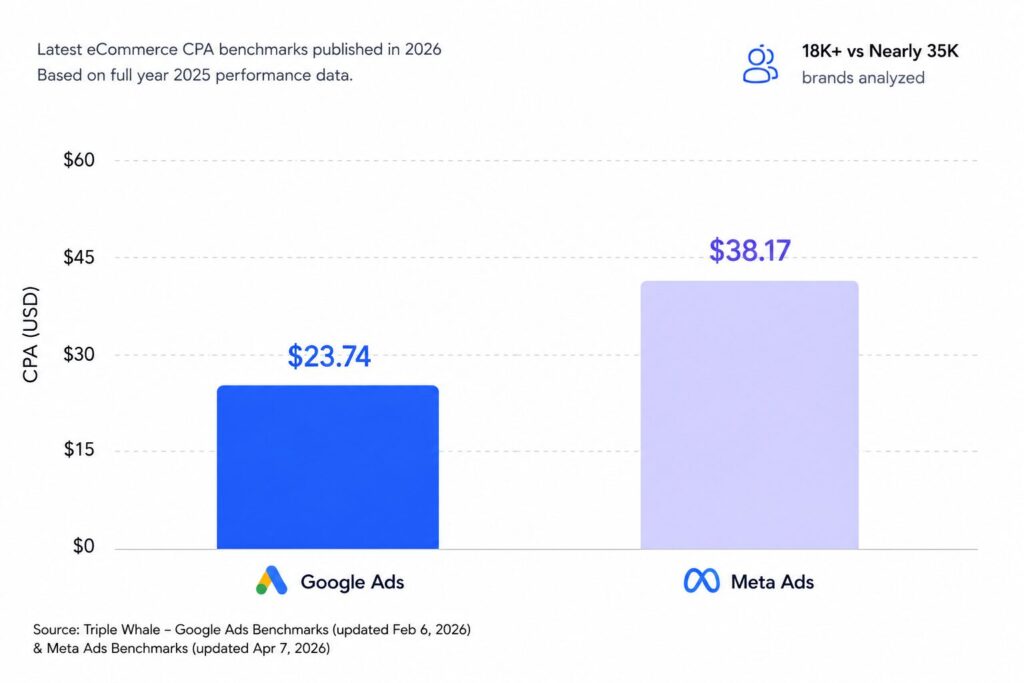
These benchmarks show why ad costs need context. Google’s median CPA in this dataset was lower, while CPM was relatively similar across the two platforms. However, this does not mean Google Ads will always cost less for an individual store. Platform-wide benchmarks include brands from different industries, price points, audiences, and campaign strategies.
Cost Is Only Part of the Comparison
Similar impression or traffic costs can lead to very different acquisition costs. Conversion rate, product price, customer intent, and campaign efficiency all influence how much a brand ultimately pays for a sale.
For eCommerce brands, four metrics provide a clearer view of advertising costs and returns:
- CPA / CAC: How much it costs to generate a purchase or acquire a customer.
- ROAS: How much revenue each dollar of ad spend generates.
- AOV: How much revenue the average order produces.
- Profit Margin: How much revenue remains after costs.
CPC and CPM help explain the cost of traffic and exposure, while ROAS, CAC, and other eCommerce performance metrics help determine whether that cost makes financial sense.
Triple Whale’s newer benchmarking system reflects this need for context. It compares performance across more than 60,000 eCommerce brands and allows brands to benchmark results against businesses with similar industries, revenue levels, AOVs, and channel mixes.
The better channel is not necessarily the one with the lowest benchmark CPA. It is the one that can acquire customers at a cost your margins can support.
When Should You Prioritize Google Ads?
Google Ads is a strong first choice when customers already search for products like yours. Instead of creating demand from scratch, you can reach shoppers who already know what they need and may be ready to compare options or buy.
Google Ads Makes Sense First If:
- There Is Existing Search Demand: Customers already search for your products or category through branded and non-branded search.
- Purchase Intent Is Clear: Relevant searches indicate that shoppers may be close to a purchase.
- Customers Compare Options: Price, features, specifications, or brands influence the decision.
- Your Products Fit Shopping Ads: Product images, prices, and feed data help customers evaluate the offer quickly.
For example, a store that sells replacement refrigerator filters can reach customers who search for a specific model or compatible filter. The demand already exists, and Google helps the store capture it.
Prioritize Google Ads when customers already know what they need and actively search for it.
When Should You Prioritize Meta Ads?
Meta Ads is a strong first choice when customers need to discover your product before they consider buying it. The platform allows eCommerce brands to generate interest through visual content across Facebook and Instagram without dependence on existing search demand.
Meta Ads Makes Sense First If:
- Your Product Is Highly Visual: Images, videos, demonstrations, or UGC can communicate its value quickly.
- Search Demand Is Limited: Customers may not know the product or category well enough to search for it.
- Your Product Benefits From Discovery: Seeing the product can create interest that did not exist before the ad.
- You Have Strong Creative Assets: Your brand can regularly produce ads that attract attention in social feeds.
This makes Meta particularly suitable for products such as fashion, beauty, accessories, home decor, and new product concepts where visual presentation can influence purchase decisions.
Prioritize Meta Ads when your main challenge is to create demand rather than capture demand that already exists.
Should You Use Google Ads and Meta Ads Together?
You do not need to choose one platform forever. The better question is whether your budget and campaign data are sufficient to support both channels effectively.
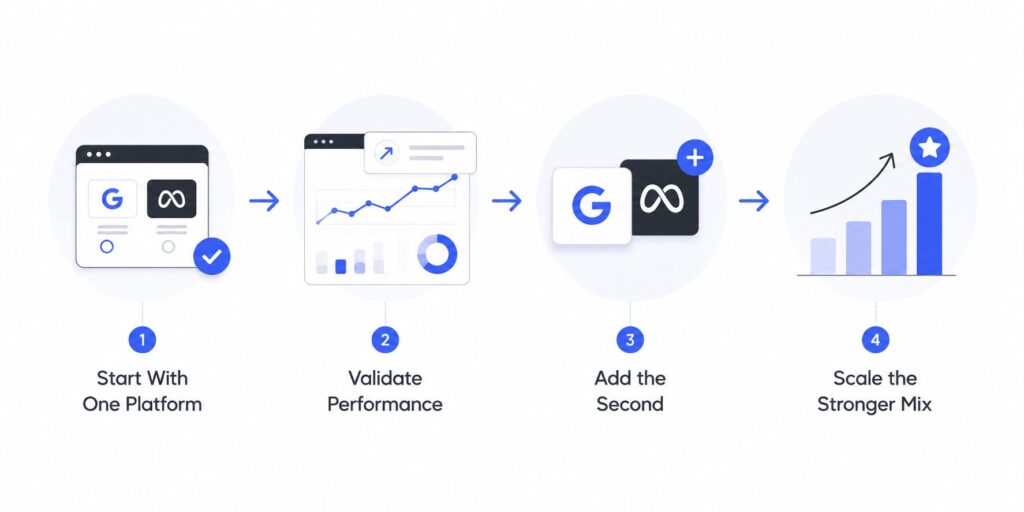
For brands with limited budgets, one platform can provide a clearer view of acquisition costs and performance. As your DTC marketing strategy develops, additional channels can support broader acquisition and long-term growth. Once results become consistent, adding the second channel can create another opportunity for growth.
Use both when you have enough budget and data to give each platform a fair test.
Google Ads or Meta Ads: Which Should You Choose First?
There is no universal first choice. The right platform depends on how customers discover your products, the demand that already exists, and the resources available to your brand.
| Choose Google Ads First If | Choose Meta Ads First If |
| Customers already search for your products | Customers need to discover your products |
| Search intent is easy to identify | Existing search demand is limited |
| Shoppers compare prices or specifications | Visual presentation drives interest |
| Your product catalog fits Shopping campaigns | You can produce strong creative consistently |
| Capturing existing demand is the priority | Creating new demand is the priority |
If both sides describe your business, start with the channel that addresses your biggest current growth constraint.
Google Ads vs Meta Ads: Final Takeaway
The right advertising channel depends on your product, customer journey, budget, and current growth priorities. Rather than looking for a universal winner, choose the platform that gives your business the clearest path to profitable customer acquisition.
If you are unsure which channel fits your product, budget, and growth goals, reach out to VIDEN Growth. Our team can help you evaluate your options and build a paid advertising strategy around your business.
FAQ
Neither platform is universally better. Google Ads often suits products with existing search demand, while Meta Ads can be more effective when customers need to discover the product first. The right choice depends on your product, customer journey, budget, and acquisition goals.
There is no consistently cheaper platform because both use auction-based pricing. Costs vary by industry, audience, competition, campaign setup, and other factors. Instead of CPC or CPM alone, eCommerce brands should compare CPA, ROAS, and profitability.
Start with Google Ads if customers already search for products like yours and show clear purchase intent. Consider Meta Ads first if your product relies more on visual discovery, has limited search demand, or needs creative to generate interest.
Yes. The platforms can complement each other, but you need enough budget and data to evaluate both effectively. With a limited budget, it may make more sense to establish one channel first and add the second after you have consistent performance data.
There is no universal starting budget. The appropriate amount depends on your product price, margins, target CPA, conversion rate, market, and growth goals. Your budget should be large enough to generate meaningful campaign data without exceeding the acquisition cost your business can support.