
Meta’s average price per ad rose 14% year over year in Q3 2026. Each pet owner you reach now costs more.
And the old fix no longer works. Interest stacks and one hero video lose to accounts that feed Meta lots of different creative, so CPA creeps up month after month.
Meta ads work for pet eCommerce brands when four things line up: varied creative with real pets and real problems, a product catalog Meta can read, broad Advantage+ sales campaigns, and a CPA ceiling set from lifetime value. This guide covers each step, from creative and catalog to scale, with examples for each pet category.
Key takeaways
- Creative now does most of the audience work. Meta’s Andromeda system picks which ads enter each auction, and varied concepts reach more types of pet owners.
- Start with Advantage+ sales campaigns and broad audiences. Keep manual controls for location, exclusions and the split between new and current customers.
- Set your CPA ceiling from lifetime value, not first-order ROAS. A food subscriber and a one-time toy buyer are worth very different amounts.
- Treat your catalog and product pages as part of the ad: clear titles with species and size, pet photos in the feed, and a fast mobile checkout.
- Launch new concepts every week and judge them on hook rate, CPA and new-customer revenue.
- Grow in two directions: raise budgets on proven campaigns, and add new angles, species and pet problems.
How Meta Andromeda Picks Ads and What It Means for Pet Brands
Meta Andromeda is the retrieval system that decides which ads enter each auction on Facebook and Instagram. In practice, it now picks your audience mostly from your creative.
- Andromeda builds the shortlist. For each impression, Meta narrows tens of millions of eligible ads down to a few thousand. Miss the shortlist and your bid never counts.
- Creative is the audience signal. A video about a senior Lab with stiff joints tells Meta who should see it better than any interest list.
- Advantage+ sales campaigns are the default. They replaced the older ASC campaign type.
So: fewer campaigns, broader audiences and a steady flow of truly different ads.
What to Set Up Before You Spend on Meta Ads
Four things decide whether your ads can work at all: clean purchase data, a product catalog Meta can read, a CPA ceiling you can afford, and an offer that makes the first order an easy yes.
Set Up Conversions API and Clean Purchase Events
Run the Meta Pixel and the Conversions API together, with deduplication on. Browser limits and ad blockers hide part of your sales from the pixel, and server events fill that gap. On Shopify, Meta’s official sales channel app connects both in a few clicks.
Then open Events Manager and check two things. First, the Purchase event fires once per order. Second, event match quality looks healthy. Double purchase events are a very common slip: they make results look better than they are and teach Meta to chase the wrong people.
Get Your Product Catalog Ready for Meta
Catalog ads match products from your feed to each shopper, so the feed needs to say what each product is and which pet it’s for. On Shopify, the same Meta sales channel app keeps your catalog in sync.
- Titles: species, life stage, flavor and size, such as “Salmon Dry Cat Food, Adult, 4 lb.”
- Images: a photo of a pet with the product next to the plain packshot.
- Product sets: group items by species, category and margin, so you can run a dog set and a cat set and keep low-margin items out of ads for new shoppers.
- Stock and prices: hide sold-out sizes and keep sale prices current, so no ad sends people to a dead end.
Catalog ads aren’t only for retarget. Meta can also show your catalog to broad audiences of new shoppers, which suits stores with many products.
Work Out Your Allowable CAC From Lifetime Value
Pet consumables repeat, so first-order ROAS undersells them. Set your ceiling from the contribution you earn over a payback window you can fund, such as six or twelve months.
Max CAC = AOV × contribution margin × orders in payback window
Here’s how much that changes the picture (illustrative numbers):
| Fresh food subscription | One-time toy order | |
| Average order value | $60 | $35 |
| Contribution margin after product cost, delivery and fees | 40% | 45% |
| Orders in the first 6 months | 4.0 | 1.2 |
| Max CAC at 6-month break-even | $96 | $18.90 |
Between August 2025 and July 2026, Triple Whale data put the Pets & Animals median on Meta at a $38.51 CPA and a 1.60 ROAS, below the 1.88 platform median. A CPA near $39 is a bargain for the subscriber and a loss on the toy, so use your own cohort data, or start from first-order margin and revisit after 90 days.
Heavy, bulky items like kibble and litter cost a lot to ship, so check margin per order after delivery. Bundles, a free-delivery threshold just above your average order, and subscribe-and-save all lift AOV and give you more room on CAC.
Choose an Offer That Lowers the Risk of a First Try
Pet owners have one big worry: will my pet like it, and will it agree with them? Offers that remove that risk win.
Good options to test:
- A sampler or trial size
- A subscribe-and-save discount
- A money-back promise if the pet refuses it
- A free add-on with the first box (a scoop, a container, a toy)
What Pet Ad Creative Works Best on Meta
The pet ads that work best on Meta show a real pet with a real owner, name a problem in the first second, and back the claim with proof. Your job is to give Meta lots of clear, different reasons for people to stop.
Why Creative Now Picks Your Audience
Andromeda reads what an ad shows and says, then matches it to people who respond to that kind of message. So “different” has to mean a different idea, not a new color on the same video.
Change at least one of these in each new concept:
- Motivator: health worry, convenience, price per day, pride, humor.
- Persona: new puppy owner, senior dog parent, multi-cat home, busy professional.
- Format: selfie-style UGC, product demo, expert explainer, bold static, carousel.
- Messenger: a customer, a vet or trainer, the founder, or the pet’s own point of view.
8 Creative Angles That Work for Pet Brands
| Angle | Best for | Example hook to adapt |
| Pet reaction | Food, treats, toys | “Watch what happens when I open the fridge.” |
| Symptom first, then fix | Supplements, specialty food | “If your dog licks his paws every night, this is for you.” |
| Owner testimonial | All consumables | “I tried four foods before this one stuck.” |
| Expert explainer | Gut, skin, dental and joint care | “A vet tech on the real reason behind bad breath.” |
| Proof with a number | Supplements, litter, pet tech | “Fresher breath in four weeks, or your money back.” |
| Chore removal | Litter boxes, feeders, trackers | “I haven’t scooped a litter box since March.” |
| Price per day | Premium food, supplements | “Less than a coffee a day for a happier gut.” |
| Breed or life stage | Food, joint care, beds | “Big dog, stiff after the park? Read on.” |
Formats and Placements
- Vertical video (9:16) for Reels and Stories, with Advantage+ placements left on. This carries most cold traffic.
- Static images with one bold claim or offer, for retarget ads and promos.
- Catalog and partnership ads. Catalog ads pull products from your feed and match them to each shopper; partnership ads run a creator’s post from their own handle.
How to Source Pet UGC at Scale
- Put an insert card in every box that asks for a short clip of the first meal, with a small reward.
- Ask for a video in a post-purchase email around day 14, with written usage rights in the same form.
- Hire creators who own the species or breed you sell, and run their posts as partnership ads.
How to Target Pet Owners on Meta
The best way to target pet owners on Meta is a broad Advantage+ sales campaign with your location set, customer lists added as suggestions, and creative that names the species, breed or problem. Keep manual controls for exclusions and for new vs current customers.
Start Broad With Advantage+ Audience
In an Advantage+ sales campaign, set your location and leave the rest open. You can add audience suggestions, such as a customer list or past purchasers, and Meta treats them as hints rather than walls. Old interest stacks like “dog owners + organic food + yoga” mostly shrink the pool the system is allowed to explore.
Where Manual Controls Still Matter
- Location. Only the places you ship to. Leave out regions where delivery costs eat the margin on heavy orders.
- New vs current customers. Build a custom audience of current customers from your customer list. Meta’s developer docs show how to split a sales campaign into two ad sets, one that includes them and one that excludes them, so you control how much spend goes to people who already buy.
- Exclusions. Keep active subscribers out of discount offers. Nobody likes to see a 50% deal on the food they already pay full price for.
Let Creative Segment for You
Species, breed, life stage and problem now do the job interests used to do. A cat-only ad finds cat owners. A joint-care ad with a gray-muzzled Lab finds owners of older dogs. Build at least one concept for each segment that matters to your revenue.
Retarget and Retain
- Site visitors and cart abandoners: catalog ads with the exact product they viewed, plus a happy-pet clip.
- New buyers: a reorder reminder timed to the pack size, such as day 25 for a 30-day bag, with an offer to subscribe.
- Subscribers: new products only, such as treats for food buyers or dental care for supplement buyers. Run the same cross-sell in email and SMS.
Keep this budget small. Advantage+ sales campaigns already reach many warm shoppers on their own.
How to Structure Meta Campaigns by Budget
Keep the account as simple as your budget allows. Every extra campaign splits your purchase data, and each ad set needs about 50 purchases a week before Meta’s delivery settles.
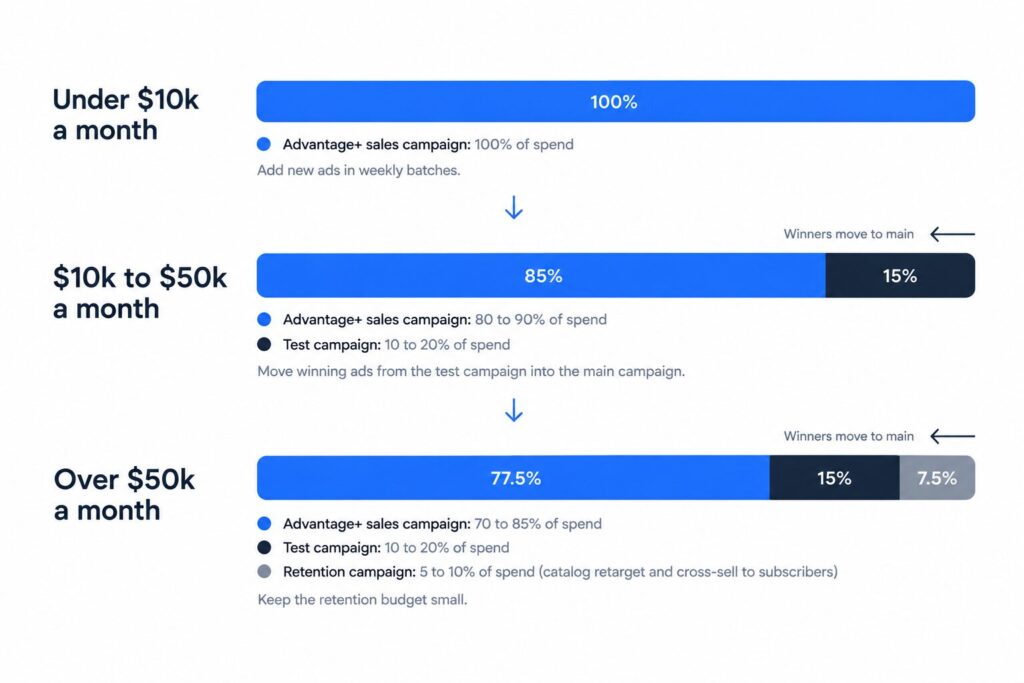
Read it left to right as your spend grows. Under $10k a month, run one Advantage+ sales campaign and add new ads to it in weekly batches. From about $10k, split off a test campaign with 10 to 20% of spend and move winners into the main campaign. Above $50k, add a small retention campaign for catalog retarget and cross-sell to subscribers.
How to Test Meta Ad Creative and Beat Fatigue
Judge each new ad on hook rate, CTR and CPA, and treat creative as a pipeline: new ideas go in every week, winners get more budget, and losers get cut fast.
Concepts vs Iterations
A concept is a new idea: a new angle, persona or format. An iteration is the same idea with a new hook, first frame, length or caption. Most weeks, ship a mix of both: a couple of fresh concepts plus a few versions of last week’s winner. At mid five figures a month, 5 to 10 new ads a week is a good start for a consumable brand.
Test new ads in a separate campaign and move winners into the main one. Add new ads in weekly batches rather than one a day, since each addition counts as a significant edit and resets the ad set’s calibration.
Metrics That Tell You a Creative Works
| Metric | How to calculate it | What it tells you |
| Hook rate | 3-second video views ÷ impressions | Does the first frame stop the scroll? |
| Hold rate | ThruPlays ÷ 3-second video views | Do people stay for the story? |
| CTR | Clicks ÷ impressions | Does the ad earn the visit? The median for Pets & Animals is 2.37% |
| CPA and new-customer share | Spend ÷ purchases; new buyers ÷ all buyers | Does it bring buyers you didn’t already have? |
| Frequency next to CPA | Impressions ÷ reach, tracked over time | Is the ad tired? |
A simple rule of thumb: once a test ad has spent about twice your target CPA with no purchase, pause it. If an ad has a strong hook rate but weak CTR, keep the opener and rework the offer or the middle of the video.
One quirk to know: Andromeda sorts ads into clusters, so ads that look alike act as one option and tend to wear out at the same pace. When a whole group slows down at once, you need a new concept, not a new color.
How to Scale Meta Ads for a Pet Brand
To scale Meta ads for a pet brand, raise budgets 15 to 20% at a time on campaigns that hold their CPA (vertical), and add new concepts that reach new groups of buyers (horizontal). Healthy pet accounts do both.
Signs You Are Ready to Scale
- CPA has stayed under your lifetime-value ceiling for at least two weeks.
- Your main ad set gets about 50 purchases a week.
- You have two or three proven concepts, and stock can handle 30 to 50% more orders.
Vertical: Raise Budgets Without a Reset
Meta treats big budget jumps as a significant edit. Changes above roughly 20% can send an ad set back to square one. So raise budgets in steps of about 15 to 20% every few days on campaigns that hold their CPA.
Need to move faster? Duplicate the campaign at a higher budget and let both run. A cost cap or a ROAS goal works as a guardrail, and once volume allows, pass real order values so Meta can bid for value.
Horizontal: New Concepts, Species, Problems and Markets
Each new angle reaches a new group of owners. Good places to look:
- New pet problems: joints, gut, anxiety, dental, weight.
- New species or life stages: a cat line, a senior formula, a puppy starter kit.
- New entry offers: a sampler, a bundle, a free gift with a subscription.
- New markets and SKUs, so catalog ads have more to match.
In the Andromeda era, horizontal growth means new ideas inside your main campaign, not a stack of new ad sets.
When You Hit a Ceiling
Work through these checks in order:
- Frequency and CPM rise on older ads. Your creative is tired. Launch new concepts.
- CTR holds but conversion rate drops. The problem sits after the click: product page, price or offer.
- All ads slow down at once. Your concepts are too similar. Change the motivator or persona, not just the visuals.
- Ads Manager looks great, but the bank account doesn’t. Platform reports include people who would have bought anyway. Run a Meta Conversion Lift study or a geo holdout test, and track MER (total revenue ÷ total ad spend), AOV and new-customer revenue from your store data next to platform ROAS.
Check the Product Page Before You Blame the Ads
Meta can only deliver the click. The page has to close the sale, so check these before you raise budgets:
- The right destination: a product page for one hero item, a collection for a range, or a short quiz when the right food depends on the pet.
- Proof near the price: reviews with photos of real pets.
- Subscription on the product page, with the discount shown in dollars.
- A fast mobile checkout with express payment options, since most Meta traffic arrives on phones.
Meta Ad Playbooks by Pet Category
The same account setup works across the pet aisle, but the angle, the offer and the number you watch change a lot by category.
| Category | Angles that tend to win | Entry offer | Main KPI | Watch out for |
| Food and treats (subscription) | Pet reaction, picky-eater fix, “more good years” | Sampler, or a big first-box discount plus a guarantee | Subscription starts and 90-day retention | Discount hunters who cancel after box one |
| Supplements (joints, gut, skin, dental) | Symptom first, expert explainer, proof with a number | Bundle or subscribe-and-save | CPA against 6-month LTV | Disease claims (see the next section) |
| Toys and accessories | Durability demo, humor, gift ideas | Bundle, free delivery over a set amount | First-order ROAS and AOV | Low repeat rate, so no LTV safety net |
| Pet tech (litter boxes, GPS collars, feeders, cameras) | Chore removal, comparison with a cheaper substitute, app demo | Pay over time, trial period | Cost per purchase and return rate | Long research cycles, so retarget for 30 days or more |
| Coat care and hygiene | Before and after, short tutorial | Starter kit | CPA and repeat rate | Results must be typical, not a best case |
A tip for pet tech: name the cheap option your buyer already uses, such as a basic Bluetooth tag instead of a GPS collar. The ad meets people in the middle of a comparison they already make.
What Pet Brands Can (and Can’t) Say in Meta Ads
Pet brands can say a product supports health, but not that it treats, cures or prevents disease. In the US, the FDA says such claims can signal that a product is a new animal drug, which needs approval first. The FDA also reviews some specific pet food claims, such as hairball control or urinary tract health.
So pick phrases from the safe side:
| Safer phrase | Risky phrase |
| Supports healthy joints | Treats arthritis |
| Helps maintain healthy skin and coat | Cures allergies |
| Supports healthy digestion | Stops diarhea |
| Fresher breath in four weeks (with study data behind it) | Prevents gum disease |
Back every number with data you can show, get written permission for every pet that appears in an ad, and check Meta’s current ad policies before launch. This is general guidance, not legal advice.
Seasonal Calendar for Pet Brands
Pet demand is steady, since food and litter run out every month, but a few windows pay off if you plan 6 to 8 weeks ahead.
| When | What happens | What to run | Creative ready by |
| January | New year health resets | Supplements, diet switches | Mid November |
| March to May | Spring shed, allergies, start of flea and tick season | Coat care, allergy support, flea and tick products | Late January |
| June to August | Summer trips, heat, July 4 fireworks | Calm aids, carriers, cool mats, GPS collars | Early May |
| August 26 and October 29 | National Dog Day and National Cat Day | Species-specific offers, photo contests | 6 to 8 weeks before |
| November to December | Black Friday and holiday gifts | Gift bundles, gift subscriptions | Late September |
Expect higher CPMs in Q4, so build retarget pools in October for Black Friday week.
FAQ
Yes, if your numbers work beyond the first order. In Triple Whale’s August 2025 to July 2026 data, pet brands converted at 1.63% after the click, above the 1.53% median across all categories. Repeat orders on food, treats and supplements let you pay more per customer than most categories can.
Enough for about 50 purchases a week in your main ad set, since that’s roughly what Meta needs before delivery settles. Multiply your target CPA by 50, then divide by 7 for a daily budget. At the Pets & Animals median CPA of $38.51, that’s about $275 a day.
The latest medians for Pets & Animals are a $38.51 CPA and a 1.60 ROAS. A “good” number depends on your margin and repeat rate, so set the bar from lifetime value. A subscriber worth $96 in six months can carry a far higher CPA than a one-time toy buyer.
Yes, once you sell more than a few products. Catalog ads show each shopper the items they’re most likely to buy, and they work for past visitors and new audiences alike. They need a clean feed: titles with species and size, photos with pets, and current stock and prices.
With care. In the US, claims that a product treats, cures, prevents or mitigates disease can make it an unapproved animal drug in the FDA’s eyes. Stick to phrases like “supports healthy joints,” back any number with data, and check Meta’s ad policies before launch.
Most pet eCommerce brands start on Meta, thanks to its broad age reach, mature purchase optimization and catalog ads. TikTok works well for impulse items and creator content. Start where your buyers spend time, then reuse your best Meta videos on TikTok once they prove themselves.
Wrap-Up
Meta still works for pet brands, but it rewards a different setup than it used to. Get clean purchase data and a clean catalog, set your CPA from lifetime value, ship new concepts every week, and keep the structure simple. Once the numbers hold, grow both ways: more budget on proven campaigns and new angles for new groups of pet owners.
Want a second pair of eyes on your account? Our Meta ads team can review your setup, from purchase data and catalog to creative, and point out what to fix first.