
Meta says its latest Q4 2025 incremental attribution model rollout drove 24% more incremental conversions compared with its standard attribution model.
That difference highlights the core problem with Facebook Ads measurement: Meta, third-party attribution tools, and incrementality tests can all report different results for the same campaigns.
In this article, we’ll break down what each method actually measures, why the numbers differ, and which approach to use when evaluating Facebook Ads performance.
Why Facebook Ads Attribution Numbers Don’t Match
Open Meta Ads Manager, GA4, and a third-party attribution tool, and you’ll likely see three different answers to the same question: how many conversions did Facebook Ads generate?
The discrepancy exists because these platforms don’t measure conversions the same way. Each uses different data, attribution windows, and rules for deciding when Facebook deserves credit for a sale.
The biggest differences come from:
- Attribution windows. Meta can credit a conversion that happens days after someone interacts with an ad, while another tool may use a shorter window or different attribution rules.
- View-through conversions. Meta can attribute purchases to people who saw an ad but never clicked it. Many third-party tools have less visibility into these impressions or treat them differently.
- Cross-device behavior. Someone might see an ad on their phone and purchase later on a laptop. Meta can use its own platform signals and modeling to connect some of these interactions, while third-party tools rely on the data they can independently observe.
- Cross-channel overlap. A customer might interact with Facebook, Google, email, and organic search before buying. Different attribution models can give credit to different touchpoints.
- Modeled vs observed conversions. Meta uses modeling to account for conversions it can’t directly observe, while third-party platforms may use different models or rely more heavily on first-party tracking.
So a higher conversion count in Meta doesn’t necessarily mean Meta is wrong, and a lower number in a third-party tool doesn’t automatically make it more accurate. In many cases, they’re simply applying different measurement rules.
The Three Ways to Measure Facebook Ads
Meta reporting, third-party attribution tools, and incrementality testing are often treated as competing measurement methods. In practice, they answer different questions.
| Measurement method | Main question it answers |
| Meta reporting | Which conversions can Meta attribute to your ads? |
| Third-party attribution | Which channels and touchpoints should get credit for a conversion? |
| Incrementality testing | How many conversions happened because of your ads and wouldn’t have happened otherwise? |
The key distinction is that attribution assigns credit for conversions that happened, while incrementality estimates whether advertising actually caused additional conversions.
How Meta Ads Reporting Works
Meta Ads Manager attributes conversions based on interactions people have with your ads within a selected attribution window. Depending on the setup, this can include clicks, views, and other engagements that happen before a conversion.
What Meta Counts as an Attributed Conversion
Meta reporting can attribute conversions through several interaction types, including:
- Click-through attribution credits a conversion when someone clicks an ad and converts within the attribution window.
- View-through attribution credits a conversion when someone sees an ad, does not click it, but converts later within the attribution window.
- Engage-through attribution can credit eligible conversions after certain video ad engagements, even when no click occurs.
Meta combines signals from sources such as the Meta Pixel and Conversions API with its own platform data and statistical modeling. This gives Meta visibility into customer interactions that may not appear in standard web analytics.
When Meta Reporting Is Most Useful
Meta reporting is most useful for decisions inside the Meta ecosystem. It provides fast feedback on which campaigns, ad sets, audiences, and creatives are generating attributed results, which makes it practical for day-to-day optimization and budget allocation within the platform. It also gives Meta’s delivery system the conversion signals it needs to optimize campaigns toward the desired outcome.
Where Meta Reporting Falls Short
The main limitation is that Meta primarily sees the customer journey from its own perspective. It has less visibility into interactions with other marketing channels, while view-through and modeled conversions can make its reported results difficult to reconcile with analytics or backend data.
More importantly, attribution shows that a conversion happened after an ad interaction, not that the ad caused it. A customer who was already likely to purchase can still be attributed to Facebook if their conversion falls within Meta’s attribution rules.
How Third-Party Attribution Tools Work
Third-party attribution tools combine data from ad platforms, websites, eCommerce systems, and CRM tools to build a broader view of the customer journey. Their goal is to compare channels using one consistent attribution framework instead of relying on each platform’s own reporting.
What Data Third-Party Tools Use
These tools typically combine first-party website data, campaign data, transaction data, and customer identifiers from eCommerce or CRM systems. Some also use server-side tracking to capture conversions that browser-based analytics may miss.
How They Assign Credit
Third-party platforms can apply different attribution models, such as first-click, last-click, linear, time-decay, or data-driven attribution. The same conversion can therefore receive different credit depending on the model selected.
Where Third-Party Attribution Is More Useful
Third-party tools are most useful when a business runs several paid channels or has a longer customer journey. They help compare Meta with Google, TikTok, email, organic traffic, and other sources using the same measurement framework.
Where Third-Party Attribution Still Falls Short
Third-party tools still depend on the data they can observe and the rules used to assign credit. They can reduce platform bias and improve cross-channel visibility, but they cannot fully reconstruct every customer journey or prove that an attributed channel caused the conversion.
What Incrementality Testing Tells You That Attribution Can’t
Attribution identifies which ads or channels receive credit for a conversion. Incrementality testing asks a different question: would those conversions have happened without the advertising?
Incrementality tests compare outcomes between people or markets exposed to advertising and a control group that is not exposed. The difference between them represents incremental lift, or the additional results caused by advertising.
Meta Incremental Attribution vs Incrementality Testing
Meta’s Incremental Attribution estimates which conversions are likely incremental and can optimize delivery toward those outcomes. Incrementality testing relies on an experimental control group to measure causal impact more directly.
| Method | How it works | Best for | Main limitation |
| Meta Incremental Attribution | Models which conversions are likely incremental | Ongoing campaign optimization | Relies on modeled estimates |
| Conversion Lift | Compares conversion rates between exposed and control groups | Measuring causal lift within Meta | Requires sufficient scale and conversion volume |
| Geo experiments | Compares markets with different levels of ad exposure | Measuring broader business impact | Requires careful market selection and test design |
| Holdout tests | Excludes part of the eligible audience from advertising | Measuring conversions that would occur without ads | Sacrifices some potential reach during the test |
These methods differ in setup, scale, and complexity, but they address the same fundamental problem: attribution can show which conversions are associated with advertising, while incrementality helps determine how many additional conversions the advertising actually caused.
Meta Reporting vs Third-Party Attribution vs Incrementality Testing
Each measurement method provides a different view of Facebook Ads performance. The right choice depends on whether you need to optimize campaigns, compare marketing channels, or validate the actual business impact of your ad spend.
| Meta reporting | Third-party attribution | Incrementality testing | |
| Main question | Which conversions can Meta attribute to its ads? | Which channels and touchpoints should receive credit? | How many additional conversions did advertising cause? |
| Best for | Campaign optimization | Cross-channel measurement | Budget and impact validation |
| Data scope | Primarily Meta ecosystem | Multiple marketing and business data sources | Test and control groups |
| Speed | Near real-time | Near real-time | Requires a testing period |
| Cross-channel visibility | Limited | High | Depends on test design |
| Measures causality | No, except modeled estimates from Incremental Attribution | Generally no | Yes |
| Setup complexity | Low | Medium | High |
| Main limitation | Limited view outside Meta | Depends on observable data and attribution rules | Requires sufficient scale and careful test design |
Which Facebook Ads Measurement Method Should You Use?
There is no single measurement method that works best for every decision. In most cases, the right approach depends on what you are trying to learn from the data.
Use Meta Reporting for Campaign Optimization
Meta reporting is the most practical option for day-to-day decisions within Ads Manager. Use it to compare campaigns, ad sets, and creatives, monitor performance, and make optimization decisions based on consistent platform data.
Use Third-Party Attribution for Cross-Channel Measurement
Third-party attribution becomes more useful when Meta is only one part of your marketing mix. It can help compare Facebook Ads with Google, TikTok, email, and other channels under the same attribution framework.
Use Incrementality Testing for Budget and Impact Validation
Incrementality testing is most valuable when you need to determine whether Facebook Ads are generating additional business results. Use it to validate large budget decisions, measure lift, and identify cases where strong attributed ROAS does not translate into comparable incremental growth.
In practice, these methods work best together rather than as alternatives. Meta can guide campaign optimization, third-party attribution can provide cross-channel context, and incrementality testing can validate whether the resulting ad spend is actually creating additional value.
Example: Why Meta, Third-Party, and Incremental ROAS Can Differ
Suppose a brand spends $25,000 on Facebook Ads during a given period. The same campaigns can produce very different ROAS figures depending on how performance is measured.
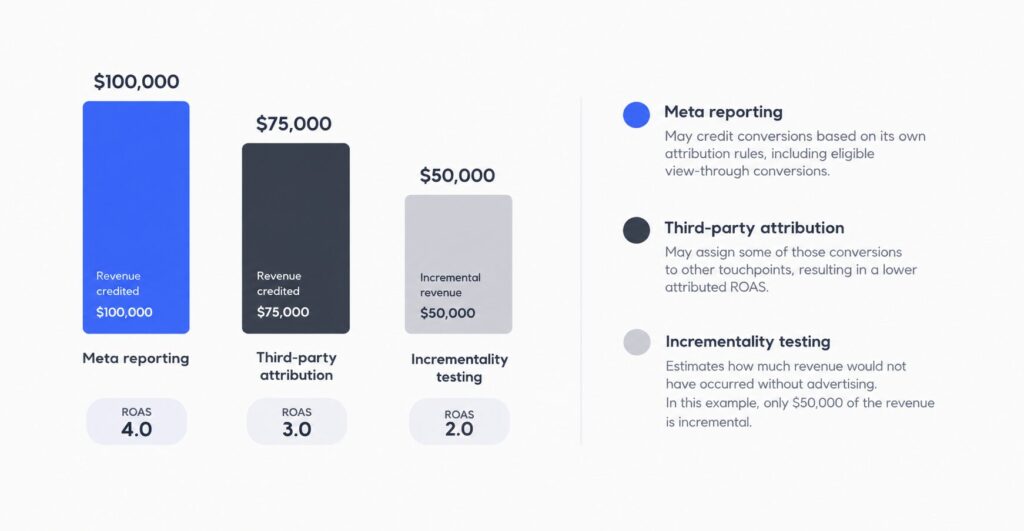
Meta may report $100,000 in attributed revenue and a 4.0 ROAS, while a third-party tool credits $75,000 and reports a 3.0 ROAS. An incrementality test may find that only $50,000 of revenue was actually incremental, resulting in a 2.0 incremental ROAS.
These figures are not necessarily contradictory. Meta applies its own attribution rules, third-party tools redistribute credit across observable touchpoints, and incrementality testing estimates how much additional revenue the advertising actually caused.
Better Facebook Ads Measurement Starts With the Right Question
There is no single source of truth for Facebook Ads measurement because each method answers a different question. Meta reporting is built for campaign optimization, third-party attribution adds cross-channel context, and incrementality testing helps determine whether advertising is actually creating additional business results.
Not sure which measurement approach fits your current setup or how to reconcile conflicting Facebook Ads data? VIDEN Growth can help you build a measurement framework that matches your channels, data stack, and business goals.
FAQ
Meta and third-party tools use different data sources, attribution windows, and rules for assigning conversions. Meta can also credit eligible view-through conversions and use modeled data that may not be available to external platforms. As a result, Meta can report more conversions without either system necessarily being incorrect.
Meta attribution can be useful for measuring and optimizing performance within the Meta ecosystem, but attributed conversions should not automatically be treated as conversions caused by advertising. Meta reporting has limited visibility into other channels and uses its own rules to determine when an ad receives credit.
Not necessarily. Third-party tools provide a more independent and cross-channel view, but they still rely on observable data and attribution models. Their main advantage is consistency across channels, not guaranteed accuracy.
Attribution determines which ad, channel, or touchpoint receives credit for a conversion. Incrementality measures whether advertising caused additional conversions that would not have happened otherwise.
Incremental ROAS, or iROAS, compares the additional revenue caused by advertising with the amount spent on that advertising. Unlike attributed ROAS, it attempts to exclude revenue that would have occurred even without the ads.
In many cases, yes. Meta reporting can support campaign optimization, while third-party attribution provides additional cross-channel context. Incrementality testing can then be used periodically to validate whether attributed performance translates into actual incremental business impact.