The sunglasses market is worth about $23 billion in 2026 and should hit $31 billion by 2031. Online sales grow even faster, at 8.3% a year.
So why do so many sunglasses brands find it hard to grow online? Their ads do great in May and fall apart in October. They raise the budget, and each sale just costs more. Usually, the ads aren’t the real problem. The brand simply has no eyewear marketing strategy that fits how people buy sunglasses.
In this guide, we’ll show you how to build one, step by step. We’ll cover the basics, the math, Meta and Google Ads, creatives, seasons and how to scale.
What Is an Eyewear Marketing Strategy?
An eyewear marketing strategy is your plan for how a glasses or sunglasses brand finds, wins and keeps customers. It covers who you sell to, how your store turns visits into sales, which ad channels you use, what your ads show, how you plan budgets by season and how you bring buyers back.
For most online sunglasses brands, it rests on six parts:
- A clear niche. Fashion, sport, eco or value. Know who you sell to and why they should pick you.
- A store that sells. Photos on real faces, exact sizes, try-on tools and reviews.
- The right numbers. Your margin, order value and break-even ROAS.
- Paid ads. Meta to find new buyers, Google to catch people who already search.
- Fresh creatives. New ad ideas every week, based on what worked before.
- Seasons and retention. A budget that follows the sun, plus email and SMS to bring customers back.
Why Sunglasses Are a Special Case for Paid Ads
Sunglasses are harder to advertise than most products. Demand depends on the season, orders are small, shoppers worry about fit and big brands crowd the auction. Here’s what each of these means for your ads.
Demand follows the sun. In the Northern Hemisphere, spring and summer bring more sales at a lower cost. Autumn and winter do the opposite. What works in June can lose money in November.
The average order is small. Most online brands sell pairs for about $40 to $250. That leaves little room for ad costs, especially on a first order.
People worry about fit. Shoppers want to know how a frame will look on their face. Without try-on tools and clear sizes, fewer people buy and more send their pair back.
Some buy fast, some take weeks. One person buys a pair in 30 seconds from an Instagram Story. Another compares polarized lenses for two weeks. Your ads need to work for both.
The big players are everywhere. Ray-Ban, Oakley and big online stores target the same people and keywords as you. You can’t outspend them, but you can stand out with a sharper message and better ads.
The Basics: How to Sell Sunglasses Online Before You Scale Ads
To sell sunglasses online with a profit, you need three things before you scale ads: product pages that answer fit questions, tracking you can trust and an offer that makes buying feel safe. Every paid click lands on a product page, so your pages set the limit for every campaign.
Product Pages That Sell
- Show the glasses on faces. Use several face shapes and skin tones. Add front, side and flat-lay shots too.
- Add a short video. A 5 to 10 second clip of someone who puts the glasses on beats any photo.
- Give exact sizes. List lens width, bridge, temple length and frame width. Explain how to compare them with a pair the shopper already owns.
- Offer virtual try-on. Shoppers now expect it in eyewear, and it takes away the fear of a bad fit.
- Explain the lenses in plain words. Say if they’re UV400, polarized or not, and what they’re made of. Answer the questions a shop assistant would get.
- Show reviews with photos. Real customers in your glasses are the best proof you can have.
Tracking You Can Trust
Your decisions are only as good as your data. Before you raise budgets, check that you have:
- Meta Pixel and the Conversions API set up together, with no duplicate events.
- Google Ads conversion tracking with enhanced conversions, plus a clean product feed in Merchant Center.
- GA4 with eCommerce events and the same UTM tags on every channel.
- One clear place to see new vs. returning customers. Your store platform usually does this.
Use Your Offer and Returns to Win Trust
Free shipping over a set amount, free returns and a clear warranty make it less risky to buy glasses online. A free hard case, a deal on a second pair or a bundle can also raise the order value. And none of these teach people to wait for a sale.
Start Your Eyewear Marketing Strategy With the Numbers
Break-even ROAS is the return on ad spend at which a first order pays for the product, shipping, fees and the ad itself. To find it, divide 1 by your contribution margin. It’s the first number a good eyewear marketing strategy needs, because it shows how much you can spend to win a customer.
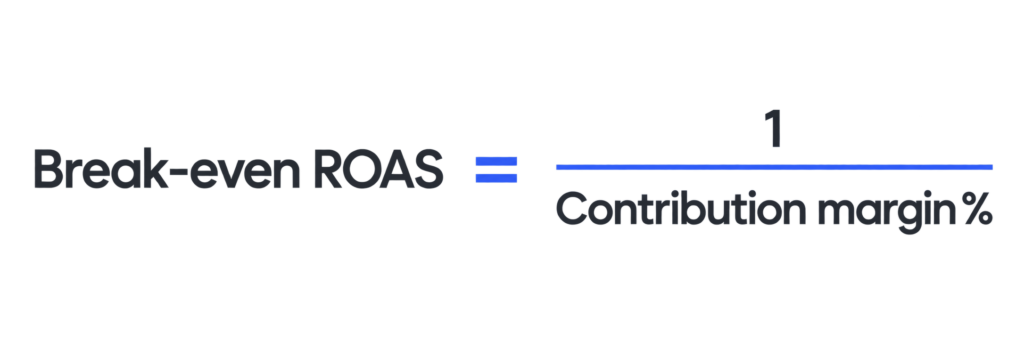
Contribution margin is what’s left from each sale after product cost, shipping, payment fees and returns, but before ads.
| Average order value | $90 |
| Product cost (COGS) | −$22 |
| Shipping and packaging | −$8 |
| Payment fees and returns | −$9 |
| What’s left before ads | $51 (57%) |
| Break-even ROAS | 1.76× |
| Max cost to win a customer on the first order | $51 |
These are example numbers, so swap in your own. Also check how often your customers buy again. If they come back within a year, you can pay more to win them the first time and make the profit on order two. Just check your own data before you count on this.
Meta Ads: How to Advertise Sunglasses on Facebook and Instagram
For most sunglasses brands, Meta (Facebook and Instagram) is where new customers find you. People rarely search for a brand they don’t know yet. They see it in their feed first.
How to Set Up Your Campaigns
Keep your account simple. That way, Meta gets enough sales data to learn from in each campaign.
- Prospecting. Run an Advantage+ Shopping campaign or a broad sales campaign that aims for purchases. Give it most of your budget. Limit how much goes to existing customers, so you reach new people.
- Creative tests. Use a separate campaign or ad set with a fixed budget. Test new ideas here, then move the winners to prospecting.
- Retargeting. Keep a small budget, usually 5 to 15% of spend, for people who viewed or added to cart but didn’t buy. Show them reviews, try-on videos and offers.
Don’t split your budget into lots of small ad sets. With a $90 order and a modest budget, each one gets too little data to learn.
Catalog Ads
Catalog ads show each person the frames they looked at, or similar ones. Use lifestyle photos in your catalog, not just plain product shots. Also tag frames by style, like aviator or cat-eye, so you can group them into product sets.
Who to Target
Once your pixel has data, broad targeting usually wins. Your ad now does the targeting for you. A video about polarized lenses for fishing will find anglers better than any interest list. Save interests and lookalikes for tests in new markets or for niche product lines.
Google Ads: Search, Shopping and Performance Max
Google Ads reaches people who already search for sunglasses, so it turns demand that exists into sales. When someone types “polarized sunglasses for men”, they know what they want. Your job is to be there with the right product at the right price.
Brand and Category Search
- Protect your brand name. It’s cheap, it converts best, and it keeps rivals and resellers off your traffic.
- Go after high-intent terms. Pick searches that match your range: frame styles, lens types, sports and audiences. Think “polarized sunglasses for driving”, “acetate sunglasses for women” or “running sunglasses”.
- Add negative keywords. Block words like cheap, free, repair, replacement lenses, and rival names you can’t win on.
Get Your Product Feed Right
Shopping and Performance Max depend on your feed. Put the key details in each product title: gender, frame shape, color, lens type and material. For example: Women’s Oversized Cat-Eye Sunglasses, Black Acetate, Polarized UV400. Add custom labels for margin, bestsellers and season. Then you can bid more on the products that make you money.
Performance Max: When It Helps and When It Doesn’t
Performance Max can grow Shopping sales fast. But it likes to spend on brand searches and retargeting, where you’d get the sale anyway. So exclude your brand terms and give your hero products their own asset group. Judge it by revenue from new customers, not total ROAS. A standard Shopping campaign next to it gives you a fair comparison.
TikTok, Pinterest and YouTube: When to Add Them
Add a third channel only once Meta and Google are stable and make money. Each new platform needs its own ads and its own test budget.
| Platform | Best for | Add it when |
| TikTok | Young, trend-led fashion brands; try-on videos; in-app sales through TikTok Shop | You can make new videos every week, or get creators to make them through TikTok Shop affiliates |
| Women’s fashion and summer outfit ideas; long time to buy | Your buyers plan looks and trips ahead, and you have great lifestyle photos | |
| YouTube | Sport glasses; videos that explain lens tech | You already have video ideas that work on Meta and want more reach |
Treat the first two or three months on a new platform as a test. Set a fixed budget and a clear goal. For example, the cost of a new customer should stay within 30% of your Meta average.
TikTok Shop and TikTok Affiliates
If you add TikTok, look at TikTok Shop, not just regular ads. TikTok Shop lets people buy your sunglasses inside the app, right from a video or a LIVE, without a trip to your site. In 2026, it works in the US, the UK, most of Southeast Asia and several EU countries. In France, Germany, Spain and Italy alone, shops sold almost €500 million in 90 days in Q2 2026.
The real engine behind TikTok Shop is the affiliate program. Creators pick your product, post videos with a shop link and earn a commission on each sale. You only pay when they sell. A common start is a commission of about 15 to 20%, plus free samples for creators who fit your style. This suits sunglasses well, because try-on videos are exactly what creators like to make.
A few tips:
- Go wide with creators. Send samples to many small creators instead of one big name. Then put ad money behind the videos that sell.
- Use GMV Max for paid ads. Since July 2025, it’s the only campaign type you can create for TikTok Shop ads.
- Count commission as a cost. Add affiliate commission to your break-even ROAS math, just like ad spend.
- Read GMV Max results with care. It counts paid, organic and affiliate sales together, so its ROAS can look better than it really is.
Eyewear Advertising Ideas That Sell
The eyewear ads that sell best show glasses on real faces: try-on videos, lifestyle shots, lens demos and content from real customers. Short vertical video is usually the best format, and carousels help you show several colors of one frame. In eyewear advertising, your ad does the targeting. With broad audiences, the ad itself decides who stops to look, so the more fresh ideas you test, the faster you grow.
The big brands treat ads like a production line. Ray-Ban, for example, has 124 ads live on Meta and adds about 19 new ones a week. You don’t need that many. But you do need a steady weekly rhythm.
Ad Ideas to Test
Do you also sell branded pairs for events or corporate gifts? Then sunglasses for marketing can be its own ad line, with its own landing page.
A Simple Test Routine
- Launch 3 to 5 new ideas every week. Give each one 2 or 3 different openings for the first three seconds.
- Judge them after a fixed spend, say two or three times your target cost per sale. Look at cost per purchase and how many people watch past the opening.
- Move the winners to prospecting. Then make new versions of them with new faces, places and openings.
- Write down what each winner has in common: format, person, place and message. Your next brief will then rest on facts, not taste.
When to Advertise Sunglasses: Plan Your Budget Around the Seasons
In the Northern Hemisphere, sunglasses sell best from May to August. Put most of your budget there and use the quiet months to test. Here’s what a typical year looks like:
Two tricks help you smooth out the year. First, sell in countries with the opposite season, like Australia, in your quiet months. Second, lean on products that sell all year, such as ski goggles, blue-light glasses or prescription sunglasses.
How to Scale Without Losing Your ROAS
To scale without losing ROAS, grow step by step and keep ROAS above your break-even line. As you spend more, each extra dollar reaches people who are less ready to buy, so ROAS drops. These five moves slow that drop down:
Grow what works, step by step. Raise the budget on your best campaigns by about 15 to 20% every few days. Don’t double it overnight. Watch the cost of a new customer, not just ROAS.
Go wider. Add new ad ideas, new product lines and new audiences. Don’t squeeze one campaign dry. Each new angle opens a new group of buyers.
Enter new markets. Pick countries with similar spending power and shipping you can handle. Use local currency, local sizes and local ads.
Raise the order value. Every extra dollar per order lowers your break-even ROAS. Bundles, second-pair deals and accessories work well for eyewear.
Bring customers back. Set up email and SMS flows: welcome, browse and cart reminders, after-purchase and win-back. Repeat sales give you more room to spend on new customers.
How to Measure What Really Works
To see what really works, look past the ROAS in your ad platforms. Meta and Google both take credit for the same sales, and neither sees the whole path to purchase. Track these three numbers instead:
- MER (marketing efficiency ratio). Your total store revenue divided by your total ad spend. Attribution settings can’t fool it.
- ROAS or cost per sale from new customers. This shows if your ads bring in new buyers or just sell again to fans you already have.
- Profit after ads. What’s left once you pay for product, shipping, fees and ads. This is the number that pays the bills.
Be careful before you cut ads that build awareness just because they look weak in last-click reports. ClickZ Eyewear shared the story of a retailer that paused these ads for eight months. Its flow of new customers dropped sharply and only came back once the ads returned. Not sure about a channel? Run a geo test or a holdout test before you switch it off.
Common Ad Mistakes Sunglasses Brands Make
Most sunglasses brands that struggle with ads make the same seven mistakes:
- They scale before tracking works. Without the Conversions API and clean events, the algorithm learns from half the data.
- They run too many small ad sets. Thin budgets never get past the learning phase.
- They run the same three ads for months. People get tired of fashion ads fast, especially in peak season.
- They only show product shots. A photo of a frame on a white background doesn’t answer the big question: how will these look on me?
- They judge Performance Max by total ROAS. A lot of its revenue can come from brand searches and people who’d buy anyway.
- They keep the same goals all year. A ROAS goal that suits December will starve your account in June.
- They lead with discounts. Constant sales teach people to wait, and they eat the margin you need for ads.
FAQ
A sunglasses brand should spend enough for each main Meta ad set to get about 50 purchases a week. That’s how much data Meta needs to leave the learning phase. Start there, then raise spend in small steps for as long as a new customer costs less than the profit from their first order.
A good ROAS for eyewear is any ROAS above your break-even point, and that depends on your margin. To find it, divide 1 by your contribution margin. A brand with a 60% margin breaks even at about 1.7, while a brand with a 40% margin needs at least 2.5.
Most new sunglasses brands should start with Meta, because people need to discover a brand before they search for it. Add a small Google brand search campaign from day one to protect your name. Then add Shopping and Performance Max once you have a clean product feed and steady traffic.
On a small budget, focus on one narrow niche, one strong store and one Meta campaign. Pick a niche like polarized fishing sunglasses or eco-friendly acetate frames. Use photos on real faces, test new ads often and collect emails from day one, so each paid visitor is worth more.
A new Meta campaign for sunglasses usually needs one to two weeks to leave the learning phase, and three to four weeks before you can judge it with confidence. Don’t change budgets or ads every day, since big edits restart the learning. Keep the season in mind too: the same ads can look weak in winter and strong in May.
Wrap-Up
There’s no magic trick to scale a sunglasses brand with paid ads. Not sure where to start? Start with your numbers and work out your break-even ROAS this week. It tells you how much you can spend, which campaigns pay off and when it’s safe to push harder. Everything else in this guide rests on it.
Curious where your eyewear ad account loses money? Book a free paid ads audit with VIDEN Growth. We’ll show you what to fix first and how to scale from there.