
Black Friday 2026 falls on November 27, and Adobe forecasts a record $275.1 billion in US online holiday spending this season, with $47.5 billion during Cyber Week alone. Last year, Shopify merchants sold a record $14.6 billion over the BFCM weekend.
But the rules have changed. AI assistants now send real traffic to stores, Google replaced Dynamic Search Ads with AI Max, and Meta’s ad system rewards different creative than it did in 2025. During the peak, click costs rise faster than conversion rates, so last year’s playbook can quietly eat your margin.
In this article, VIDEN Growth experts share the 2026 trends, a dated campaign calendar, the AI tools worth using, and 7 Meta and 9 Google Ads strategies to make this Black Friday your most profitable one.
The History of Black Friday
Black Friday, the day after Thanksgiving, is the busiest shopping day in the US, when retailers offer special deals, sales and other Black Friday promotions. In 2026, it falls on November 27.
But did you know that the Black Friday name originally came from Philadelphia, where the Army-Navy football game was played on the Saturday after Thanksgiving every year?
In the 1950s, ’60s and ’70s, the game drew massive crowds, with most people arriving on Friday and creating chaos the police had to handle. That’s how “Black Friday” appeared. Philadelphia retailers, who saw a surge in sales from all the visitors, also started calling the day Black Friday. By the 1980s, the term had spread nationwide, shedding its less-than-appealing origins for a more positive meaning. So why has this event become so crucial for businesses? Let’s find out.
Why is Black Friday so Important for Businesses?
Black Friday is the best bet to increase brand awareness, attract customers and drive sales. It’s more than a day of discounts for shoppers looking for the best deals:
- It’s a chance to hit monthly sales goals in a few days. With millions of people hunting for deals, businesses can reach more potential customers than at any other time of year and drive sales volume that might otherwise take weeks.
- It’s the perfect time to turn shoppers into loyal customers. Exceptional customer service, exclusive deals and personalized offers can turn a single purchase into a long-lasting relationship.
- It’s a data source about your customers, their buying habits and the products they love. This data feeds better decisions for the rest of the year.
Black Friday 2025 Key Numbers
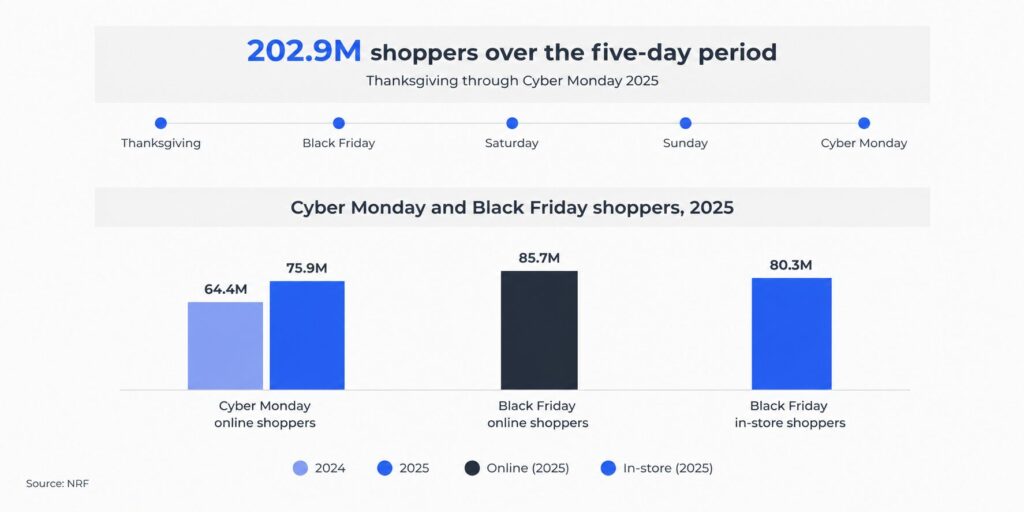
According to the National Retail Federation (NRF), a record 202.9 million people shopped online or in stores over the five days from Thanksgiving to Cyber Monday 2025. Cyber Monday grew fastest: online shoppers jumped to 75.9 million from 64.4 million in 2024, while Black Friday still drew 85.7 million online and 80.3 million in-store shoppers.
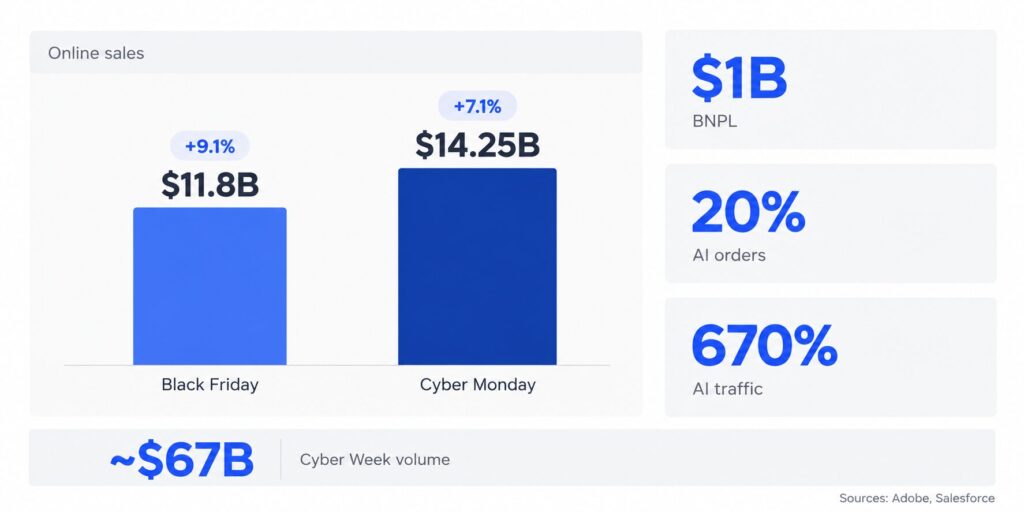
Online spending hit records too. Adobe reported $11.8 billion in online sales on Black Friday (+9.1%) and $14.25 billion on Cyber Monday (+7.1%), and buy now, pay later (BNPL) spending passed $1 billion in a single day for the first time on Cyber Monday. AI also joined the checkout: Salesforce estimates that about 20% of global orders during its Cyber Week (around $67 billion; Salesforce’s Cyber Week also counts the two days before Thanksgiving) involved AI tools or AI agents, and Adobe saw AI-referred traffic to US retail sites rise 670% year over year on Cyber Monday.
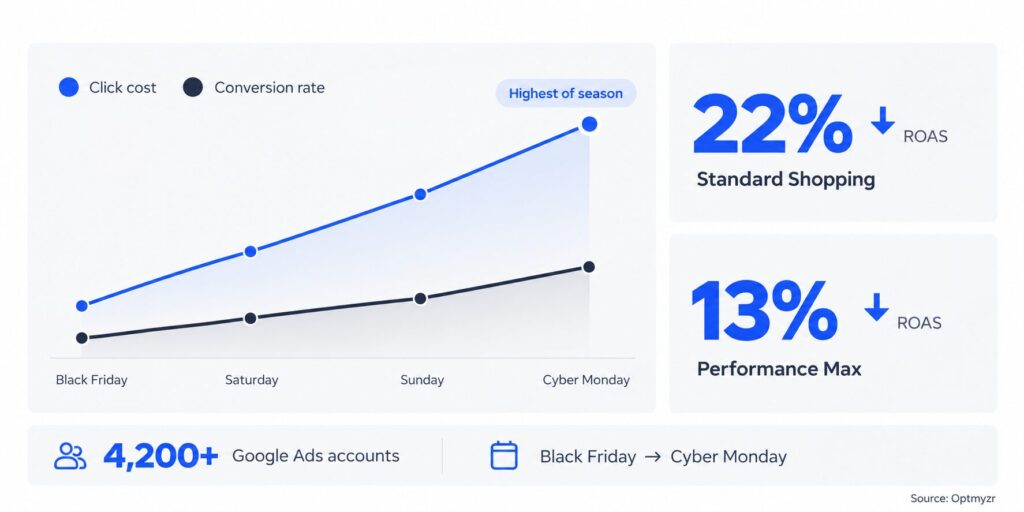
For advertisers, clicks got pricier but converted better. In an Optmyzr analysis of more than 4,200 Google Ads accounts, the four days from Black Friday to Cyber Monday 2025 had both the highest click costs and the highest conversion rates of the season. Click costs simply rose faster: ROAS fell 22% in Standard Shopping and 13% in Performance Max versus the week before.
To win this Black Friday season, businesses also need to understand the trends shaping 2026. Let’s look at them!
2026 Black Friday Marketing Trends to Follow
Our experts highlighted seven global and US trends that will shape Black Friday 2026 results:
AI Assistants Are Now a Shopping Channel
AI is no longer just a personalization feature. Adobe expects AI-referred traffic to US retail sites to grow another 130% this holiday season. Google has added checkout and a branded Business Agent to AI Mode, while ChatGPT now focuses on product discovery. AI assistants read your product feed and pages, so accurate prices, sale prices and clear comparison content decide whether you show up.
Read More: Best AI Advertising Tools
Google Universal Cart Makes Price Comparison Easier
On October 15, 2026, Google rolled out Universal Cart in the US across Search, AI Mode and the Gemini app. Shoppers can save products from different stores in one cart, get price-drop alerts and see promo codes before checkout. Your Black Friday price will be compared with competitors more easily than ever, so an active Merchant Center promotion and a clear offer matter more than the size of the discount.
Black Friday Is Now a Season, Not a Day
By Thanksgiving 2025, 84% of US shoppers had already started holiday shopping, and 62% planned to keep buying into December. Adobe expects $95.8 billion in US online spending in October 2026 alone, with discounts building through November and peaking at up to 30% during Cyber Week. Plan a campaign that runs for several weeks, not a single weekend.
Mobile Shopping and Buy Now, Pay Later Keep Growing
Adobe expects mobile to account for a record 57.4% of online holiday spending in 2026 and BNPL to reach $21.3 billion, including about $1.09 billion on Cyber Monday. If your checkout is slow on mobile or installment pricing only appears at the last step, you lose sales at the busiest moment of the year. Show BNPL options in ads and on product pages, especially for higher-ticket items.
Creators and Social Commerce Win a Bigger Share
On Cyber Monday 2025, social media’s share of online revenue jumped 56.5% year over year, to 3.6%. For 2026, Adobe expects social’s share to grow 17% and affiliates and creators to grow 12%. Creator content is no longer optional for BFCM: get partnership ads, UGC and creator videos approved before November so they’re ready for both Meta and YouTube.
Shoppers Are Value-Seeking and Compare More
Shoppers are still spending, but they compare more and wait for the right offer. In 2025, baskets grew 5% while the average spend per item fell from $47 to $45. Experian expects loyalty programs, early access and member-only pricing to matter more than blanket discounts in 2026, so segmented offers will beat “everything 30% off” for many brands.
The US Midterms Will Push Up Ad Costs in Early November
The 2026 midterms are on November 3, and AdImpact projects a record $11.6 billion in political ad spend, about $1.6 billion of it in digital. Expect extra auction pressure and higher CPMs in the US in late October and early November. As in past election years, the days right after Election Day can be a good window to scale prospecting before Black Friday competition peaks.
When to Start Your Black Friday Marketing Campaign: the 2026 Calendar
There’s no single start date that fits every ecommerce business. It depends on your brand, audience and goals. But with Black Friday on November 27 and Cyber Monday on November 30, here is a timeline we use as a starting point:
✓ Audit pixel, CAPI, Google tag & product feeds
✓ Refresh audiences & early-access lists
✓ Factor in potential US midterm CPM pressure
✓ Allow time for learning and ad reviews
✓ Scale prospecting as CPMs settle
✓ Activate early-access offers
✓ Activate promotional creatives & assets
✓ Increase budgets gradually
✓ Capture high-intent traffic before the peak
✓ Concentrate spend on winning campaigns
✓ Avoid new launches or major target changes
✓ Promote gift guides and shipping deadlines
✓ Reduce budgets as efficiency declines
Tip: It’s always easier to cut back than to scramble at the last minute. If budgets are tight, start smaller in early November and save most of your spend for the Cyber 5.
The AI Toolkit for Black Friday 2026
AI is now standard for ad teams. In an IAB survey, 86% of ad buyers said they use or plan to use generative AI for video ads, and by early 2026, 83% of ad executives said their company uses AI in creative work.
But there’s a gap: 82% of executives believe young consumers like AI-made ads, while only 45% actually do. AI wins when it makes creative better and more varied, not when it floods the feed with generic ads.
AI Agents: On the Shopper’s Side and on Yours
Shopper-side agents (ChatGPT, Google AI Mode, Gemini and Universal Cart) research products, compare deals and track prices. To show up, keep your feed complete, set up Merchant Center promotions for your offer, and make product pages answer real questions: who it’s for, how it compares, what the deal includes.
Advertiser-side agents help you run campaigns. In October 2026, Meta announced an agentic version of its AI business assistant that can create ads, update targeting and change budgets through prompts.
Google’s Ask Advisor (beta) answers questions across Google Ads, Google Analytics and Merchant Center. Use agents to flag issues during Cyber 5, but keep a human approving budget and bid changes.
AI for Research and Ideas
Free ad libraries (Meta Ad Library, Google Ads Transparency Center and TikTok Creative Center) show what competitors ran last BFCM and what they’re running now. Google Trends and Merchant Center’s best sellers reports show which products and queries are picking up.
AI assistants like ChatGPT, Claude, Gemini and Perplexity can turn hundreds of customer reviews and competitors’ past offers into objections and ad angles in minutes.
AI Assistants for Performance Analysis and Strategy
AI assistants can now read your ad accounts directly: Meta opened official Ads AI connectors, and Google released an open-source, read-only MCP server for the Google Ads API.
Use them to pull last year’s BFCM winners by creative and offer, build day-by-day pacing targets, run daily anomaly checks during Cyber 5 and tag creatives by hook and format. Start with read-only access, check key numbers in Ads Manager or Google Ads before acting, and never paste customer data into unapproved tools.
AI Creative Production Tools
| Job | Popular tools | Best for |
| Images | ChatGPT (GPT Image), Google Gemini (Nano Banana Pro), Midjourney, FLUX, Ideogram, Adobe Firefly | Product scenes, backgrounds, seasonal variations, text-heavy promo statics (Ideogram, GPT Image), brand-safe licensed outputs (Firefly) |
| Video, AI UGC and avatars | Google Veo (in Gemini and Flow), Seedance, Wan, Kling, Runway, Arcads, Creatify, HeyGen, Captions | Google Veo (in Gemini and Flow), Seedance, Wan, Kling, Runway, Arcads, Creatify, HeyGen, Captions |
| Built into ad platforms | Meta Advantage+ creative and Ads Creative Studio; Google Ads Asset Studio | Turning static images into video (Meta, generally available), creating image, video and text variations inside Google Ads with one-click A/B testing (Asset Studio, rolling out globally in English) |
| Landing pages | Shopify Magic and Sidekick, Replo, GemPages, Unbounce | Fast Black Friday landing pages and product page variants, AI copy, automatic traffic routing to the best variant (Unbounce Smart Traffic) |
How to Use AI Creative Tools So You Actually Stand Out
Use AI to vary proven concepts and real product footage, not to invent the product. With Meta’s Andromeda system, five distinct concepts beat fifty small tweaks, so test AI ads against human-made ones and keep what wins. Disclose AI content where required: Meta adds an “AI info” label, and the EU AI Act (Article 50) has applied since August 2, 2026.
7 Meta Ads Black Friday Strategies
Meta Ads is a unique opportunity for eCommerce brands to achieve explosive sales growth and attract new customers. But competition is intense, and Meta’s system changed a lot in the past year. Here are our updated Meta Ads strategies for Black Friday 2026.
1. Start Early and Test Concepts, Not Tweaks
Don’t wait until the last minute to start your BFCM campaigns. Starting small and increasing your efforts as the big day approaches gives you more control and time to adjust.
Use the pre-sale period to test, but test the right way. Meta’s Andromeda system groups near-identical ads, so a test of five product shots with slightly different copy may effectively be one ad. Test genuinely different concepts instead: a different format, a different message, a different person on camera. Fatigue is real, too: as media buyer Marin Istvanic noted in Motion’s BFCM analysis, the chance of conversion drops by around 45% after someone sees the same ad four times.
Focus your biggest push on Black Friday and Cyber Monday, the peak days of the weekend.
2. Don’t Wait for Black Friday to Fix Your Problems
If sales struggle before the big day, don’t hope Black Friday traffic will work miracles. Use this time to find and fix the root causes:
- Are your conversion rates low, especially on mobile (where most holiday spending now happens)?
- Are customers abandoning carts before checkout? Is installment payment (BNPL) visible early enough?
- Are your products priced competitively, and is your offer clear in one sentence?
- Are your product pages fast, clear and answering the questions AI assistants and shoppers ask?
- Is your tracking healthy (pixel plus Conversions API) so Meta optimizes on real purchases?
And remember that BFCM shouldn’t carry the whole year. A brand people know and trust year-round, with consistent promotions, strong customer service and always-on advertising, gets more from Black Friday than a brand that only shows up in November.
3. Don’t Reinvent the Wheel: Bring Back Last Year’s Winners
Stuck on Black Friday ideas? Look at your best ads from the past 12 months. Which ones generated the most clicks, engagement and purchases? Was it the visual, the copy or the audience?
Last year’s winners with a Black Friday sale badge are proven performers that need no new production. Use one badged version per winner rather than many near-identical copies. If a winner is a static image, Meta’s Advantage+ creative can now turn static images into video, giving you a new format from an asset you already trust.
4. Combine Advantage+ Sales Campaigns and Catalog Ads
Use Advantage+ to capture people who are about to buy and dynamic catalog ads (DPAs) to cover broader audiences.
What changed in 2026: Advantage+ Shopping Campaigns have been replaced by Advantage+ sales campaigns, and the old “existing customer budget cap” is no longer available. To control how much you spend on existing customers, use two ad sets: one that includes your customer list and one that excludes it, with a spending limit on the existing-customer ad set. Meta’s new Customer Lifecycle Strategy setting also lets you tell the system which audience each campaign should focus on.
Catalog ads are still powerful and still neglected by many advertisers. Run your evergreen catalog ads and launch Black Friday versions with BF ad copy and BF-themed frames, and make sure sale prices are updated in the catalog. Note that the standalone Advantage+ catalog campaign setup may already be unavailable in some accounts; in that case, run catalog ads inside your Advantage+ sales campaigns.
Pro tip: aim to allocate 10-15% of your Meta Ads budget to catalog ads (prospecting and remarketing).
5. Use the 5 Ad Formats That Sell on BFCM
Your Black Friday discount isn’t your competitive edge. Everyone has one. Your creative is what makes yours noticed and trusted. During BFCM week, shoppers scroll past the same “up to 50% off” dozens of times. After reviewing hundreds of BFCM ads, here are the five formats that consistently sell:
- Behind-the-scenes and comment-reply videos. People buy from brands that feel real.
- Last year’s winners with a sale badge. Proven performance, zero new production.
- Plain product plus a big discount callout. One product, one number, instantly clear.
- Text-only “50% OFF, Today Only” statics. When urgency drives the sale, minimalism wins.
- Evergreen UGC with the offer in the hook. Authentic moments plus a reason to buy now.
Most brands don’t need 40 new creatives. They need five proven formats and a clear offer. This also fits how Meta’s system works in 2026: five genuinely different formats give Andromeda real variety to work with.
Vertical video (Reels) best practices:
- Keep it under 15 seconds, with a hook in the first 2-3 seconds.
- Use bold captions and text overlays: many people watch with the sound off.
- Add movement in the first frame (zoom, pan, gesture) and monitor your hook rate.
- Raw, UGC-style videos (selfie, handheld, authentic) often outperform polished ads for conversions.
6. Partnership Ads to Expand Reach and Creative Diversity
Partnership ads let brands run content from creators, influencers or retail partners directly through Meta Ads Manager, showing the ad from both your handle and the creator’s.
Benefits:
- Extend reach by running ads from both your brand handle and a creator’s handle.
- Gain creative diversity: creators bring authentic styles that brand-only assets can’t.
- Improve trust: ads from a creator’s profile often get higher engagement and CTR.
In 2026, Meta brought creator discovery and partnership ads closer together, with a Creator Marketing Hub that offers one-click ad creation from creator content. With creators and affiliates taking a growing share of holiday sales, this is the year to have creator content approved and ready before November.
Execution tips:
- Test several creator partnerships and let Meta shift budget toward the ones driving the best results.
- Use both Reels and Stories placements to cover discovery and consideration.
- Run partnership ads inside your Advantage+ sales campaigns so the system can balance brand and creator content.
7. Measure What Actually Moved the Needle
Platform-reported results tend to look better than the true incremental impact, and this year Meta’s attribution rules for Advantage+ campaigns changed, so last year’s reported numbers aren’t a like-for-like benchmark. Before the peak:
- Run a holdout or lift test in early November to measure what your campaigns actually drive.
- Track the share of new versus returning customers weekly against your store data.
- Judge Black Friday on contribution after discounts and new-customer cost, not only on reported ROAS.
9 Google Ads Black Friday Strategies
Meta Ads spark interest, but Google Ads captures shoppers who are already searching for deals, now also in AI Mode, Gemini and Universal Cart. Google’s toolbox changed a lot this year, so here are nine tactics updated for 2026.
1. Start Early and Lock Your Structure Before the Peak
Just like with Meta Ads, launching your Black Friday campaigns early is a must to capture high-intent users searching for Black Friday deals. The data backs this up. In Optmyzr’s analysis of 4,200+ Google Ads accounts during BFCM 2025:
- The week before Black Friday was the most efficient high-intent traffic of November. Standard Shopping converted 6.2% of clicks, almost as well as the 6.7% during the four peak days, at a much lower cost per click.
- The four days from Black Friday to Cyber Monday had click costs 29% to 46% higher than the week before.
- The week after Cyber Monday quietly cost the most: Standard Shopping conversion rate fell 7.3% below its pre-BFCM level while CPC stayed 10.2% higher.
So plan three different games, not one long sprint. Upload Black Friday assets and asset groups at least two weeks before they need to go live (Google’s own recommendation for holiday asset groups), because ad and asset review slows down as the peak approaches. Then freeze your account structure: the campaigns, conversion tracking and product groups should look the same on November 27 as they did on November 9.
2. Target BF Shoppers With Search, and Keep AI Max on a Leash
Launch a Black Friday Search campaign, or Black Friday ad groups in every active Search campaign (depending on your business and account structure). This way, you catch highly relevant users looking for Black Friday deals in your industry.
What changed in 2026: AI Max for Search left beta in April 2026, and from September 2026 Google automatically upgraded campaigns using Dynamic Search Ads, automatically created assets and campaign-level broad match to AI Max. You can no longer create new DSA campaigns. If you relied on DSA last Black Friday, your account now works differently. Before the peak:
- Check which campaigns were upgraded and which AI Max features are on: search term matching, text customization and final URL expansion.
- Review URL exclusions and URL rules so final URL expansion sends Black Friday searches to your Black Friday landing pages, not to a generic category page or an out-of-stock product.
- Use brand and location controls, plus negative keywords, to keep AI Max away from queries you don’t want to pay peak prices for.
- Review the search terms report daily during Cyber 5.
AI Max matters more this year because ads in AI Overviews and AI Mode run through AI Max and Performance Max. For retailers, Google is also testing AI Max for Shopping campaigns (closed beta since April 2026), which uses your Merchant Center feed to match longer, conversational product searches.
3. Improve Your Ads With BF Assets
Enhance Search, Performance Max, Demand Gen and other campaign types with Black Friday assets (formerly called extensions): sitelinks, images and promotion assets. Name the event explicitly and select the Black Friday or Cyber Monday occasion in promotion assets, with start and end dates set in advance. “Black Friday: 30% off sitewide” works better than “Sale now on.”
Schedule your assets ahead of time rather than adding them on the day, so they’re approved and switch on and off automatically.
4. Create BF Text Ads
Create a new Black Friday responsive search ad for every ad group and add it to the rotation with your other ads. Aim for at least 40% of headlines and 50% of descriptions with Black Friday messaging. Pinned Black Friday headlines can also be tested.
Two 2026 additions:
Label your evergreen ads before you add Black Friday creative, and tag new ads with the year (“BF2026”). It sounds trivial until someone reactivates last year’s expired promotion by mistake.
If AI Max text customization is on, Google will also write headlines from your landing pages and assets. Make sure your Black Friday landing page states the offer clearly, and use text guidelines to block wording you don’t want (for example, “free shipping” if it isn’t part of the deal). Google is rolling out “AI Brief” to steer AI Max with natural-language guidance, starting in English.
5. Get Your Product Feed and Visuals Sale-Ready
Update your main product images in Merchant Center so they look appealing and clear, and add lifestyle images as additional images. Google’s AI image tools in Merchant Center and Asset Studio can help create seasonal backgrounds quickly, as long as the product itself stays accurate.
Just as important is price accuracy:
- Put the sale price in the feed, using sale price and sale price effective dates, so prices switch on and off automatically. A discount that only exists as a coupon code leaves Shopping ads showing the full price all weekend.
- Keep feed and site prices in sync. A mismatch can get products disapproved, and re-approval can take hours during peak review queues. Increase feed refresh frequency for the Cyber 5 window.
- Fill in the details AI surfaces use: shipping, returns, variants and product attributes. AI Mode and Universal Cart pull this data straight from your feed.
Google also expanded product-level reporting in June 2026 to cover Performance Max, Demand Gen and Video, so you can finally see which products drive cost and conversions across campaign types. Use last season’s view to decide which products deserve Black Friday budget.
6. Use Merchant Center Promotions, Now Also in AI Mode and Universal Cart
Merchant Center promotions help your products stand out from competitors and draw more attention to your ads and free listings. In 2026 they matter even more: Google’s Universal Cart, launched in the US on October 15, 2026, monitors prices and surfaces promo codes for items shoppers save, and AI Mode can show deal information next to products. If your Black Friday offer isn’t set up as a Merchant Center promotion, it’s harder for these surfaces to show it.
Submit promotions early and allow several days for review, double-check that promo codes work at checkout, and add promotion assets in Google Ads as well, so the offer shows across Search, Shopping and Performance Max.
7. Power Up Your Performance Max Campaigns
If you run Performance Max, create an additional Black Friday asset group with strong messaging and Black Friday banners, and use asset group scheduling to switch it on exactly when your sale starts. Run it as the main asset group or in rotation with others, depending on performance. Asset Studio can help produce Black Friday image and video variations faster.
Performance Max is also far less of a black box than it was:
Segment your catalog by margin and stock, not just by category. Sending peak-priced clicks to low-margin products or items with three units left burns budget fast. Accounts running PMax and Standard Shopping side by side ended December at almost identical ROAS (680% vs 666%), so product economics matter more than the campaign label.
Check the channel performance report before you scale. In Optmyzr’s BFCM 2025 data, YouTube drove nearly 10% of PMax impressions but only about 2% of conversion value, and Discover’s conversion rate fell by more than half between November and December.
Use negative keywords (up to 10,000 per campaign) to keep PMax off irrelevant or low-value queries.
8. Prospect and Remarket With Demand Gen Campaigns
Demand Gen is a great way to tell prospecting and remarketing audiences about your current or upcoming Black Friday offers across YouTube (including Shorts), Discover and Gmail. Focus on your best deals and clear incentives to attract new customers and convert your remarketing audience.
Google added a lot to Demand Gen in 2026: ads on Google Maps, product feeds in more formats, a way to find and boost creator videos in campaign setup, product videos from Merchant Center, and Demand Gen uplift experiments to measure incremental impact. Google also says Demand Gen conversions grew more than 30% over the previous six months.
Pro tips: use both static and video content to maximize reach, attach your product feed so ads become shoppable, and launch in early November so the campaign has learned before the peak.
9. Set Budgets and Bids With Margin Math
Three budget and bidding decisions should be made before November, not on Black Friday morning:
- Know your breakeven ROAS. It’s 1 divided by your gross margin (a 40% margin means 250%). Pick your Black Friday target between your usual target and breakeven in advance. If the gap is small, don’t chase peak volume.
- Consider campaign total budgets for a dedicated sale campaign. Since January 2026, you can set a fixed total budget for Search, Performance Max and Shopping over 3 to 90 days, and Google spends more on high-demand days. It only works for new campaigns and can’t be switched later, so it suits a standalone Black Friday campaign.
- Use seasonality adjustments only for short, unusual spikes. Smart Bidding already knows Black Friday from your history, and Optmyzr’s three-year study of 6,000 advertisers linked manual adjustments to doubled CPC inflation and falling ROAS. Use them only for events Google has no history for (a first-ever sale or an unusually deep flash sale), for 1 to 7 days.
Finally, write your mid-sale budget rules down in advance. For example: “If ROAS stays 50 points above breakeven and stock supports it, raise the daily budget by 20%.” Then set alerts so you act on the rule, not on a noisy dashboard.
Black Friday Marketing FAQs
Black Friday 2026 is on Friday, November 27, and Cyber Monday is on Monday, November 30. Mark your calendar and start planning early.
Black Friday is the biggest shopping day of the year after Thanksgiving in the US. It starts the holiday shopping season and is known for massive sales and discounts.
Start early and build buzz by announcing your Black Friday deals in advance. If you’re unsure where to start, contact a digital advertising agency that provides Google Ads services and Facebook Ads services.
The main goals of a Black Friday and Cyber Monday campaign are to boost sales, acquire new customers you can keep, and clear inventory.
Only sparingly. Smart Bidding already learns from your previous Black Fridays, and data from thousands of accounts shows manual adjustments often raise click costs. Use them for short events Google has no history for, such as a first-ever sale or an unusually deep flash sale, and keep them to 1-7 days.
Google retired them. From September 2026, campaigns using Dynamic Search Ads were automatically upgraded to AI Max for Search, and new DSA campaigns can no longer be created. Review your upgraded campaigns’ URL rules and search terms before Black Friday.
Yes, as a way to produce more varied creative faster, ideally based on real product footage and proven concepts. Test AI-made ads against your existing winners and disclose AI content where platforms or local rules require it.
Absolutely. Consumers are actively looking for deals, and the limited-time nature of offers creates urgency. In 2025, US online spending over Cyber Week reached a record $44.2 billion, and Adobe expects $47.5 billion in 2026.
Win Black Friday 2026 with VIDEN Growth
Book a 15-minute Black Friday strategy call with us. Let’s develop a winning Black Friday marketing strategy together! We’ll help you use data strategically, implement innovative ideas and build a customer-focused approach that grows your sales. Let’s turn BFCM 2026 into your biggest shopping event ever!