
Artificial intelligence is now a core part of modern marketing. According to HubSpot’s State of Marketing report, 80% of marketers use AI for content creation, while 75% use it for media production, which shows how quickly AI transforms campaign planning and execution. As these capabilities expand, retailers and eCommerce brands use AI to improve efficiency, personalize experiences, and increase return on ad spend.
Despite this adoption, choosing the right AI solution remains difficult. Many platforms promise smarter targeting, automation, and better results, but without clear insight into their strengths, businesses risk investing in tools that do not deliver real value. Working with experienced providers of AI marketing services can help businesses select the right technologies and integrate them into their broader marketing strategy.
This guide reviews the leading AI advertising tools for eCommerce and retail. It compares their features, use cases, pricing, and drawbacks to help you choose the right solution for your strategy.
What Are AI Advertising Tools?
AI advertising tools are applications and AI-powered solutions that use artificial intelligence to automate, optimize, and enhance digital advertising campaigns. They analyze data, identify patterns in customer behavior, and make real-time decisions that improve targeting, bidding, and overall campaign performance.
Unlike traditional tools, AI-powered solutions learn from results and adapt over time. They support features such as automated bid adjustments, audience optimization, and ad creative generation. For eCommerce and retail businesses, this reduces manual work and improves campaign efficiency across multiple channels, which allows teams to focus on strategy while achieving better results.
Benefits of AI Tools for Advertising
AI is transforming how eCommerce and retail businesses plan, launch, and optimize advertising campaigns. AI automates repetitive tasks and analyzes large volumes of customer data. It helps marketers make faster, more informed decisions and improves campaign performance.
Some of the key benefits include:
- Improved audience targeting. AI analyzes customer behavior, demographics, and purchase history to identify high-value audiences and deliver more relevant ads.
- Automated campaign optimization. AI continuously adjusts bids, budgets, and placements based on real-time performance, helping maximize return on ad spend (ROAS).
- Faster content creation. Many AI advertising platforms can generate ad copy, images, and videos, allowing marketing teams to launch campaigns more quickly and test multiple creative variations.
- Better personalization. AI enables businesses to deliver personalized ads based on customer preferences, browsing behavior, and previous interactions, increasing engagement and conversion rates.
- Time and cost savings. By automating routine tasks such as campaign monitoring, reporting, and optimization, AI reduces manual effort and allows marketers to focus on strategic initiatives.
- Data-driven decision making. AI processes large datasets to uncover trends, predict campaign outcomes, and provide actionable insights that would be difficult to identify manually.
For retailers managing multiple products, seasonal promotions, and advertising channels, these capabilities make AI a highly important tool for improving efficiency and driving better marketing results.
How We Use AI at VIDEN Growth
At VIDEN Growth, AI enhances the way we work and does not replace strategic thinking or marketing expertise. We use AI to automate repetitive processes, uncover deeper insights, and help our specialists make faster, data driven decisions that improve campaign performance.
Our team leverages AI to:
- Process and analyze large volumes of marketing data to identify trends, forecast performance, and support smarter budget allocation decisions.
- Monitor competitor activity in real time, including creatives, messaging, offers, pricing, and positioning, allowing us to adapt advertising strategies as the market evolves.
- Detect performance anomalies and growth opportunities early, helping us respond quickly to shifts in campaign performance and maximize ROAS.
- Analyze creative performance beyond surface-level metrics, identifying which hooks, messaging angles, formats, and visual approaches consistently drive stronger results.
- Accelerate creative production and iteration, enabling faster testing of new concepts and shortening the feedback loop without compromising creative quality.
- Interpret audience signals across platforms, uncovering behavioral patterns that inform both targeting strategies and creative direction.
- Turn complex marketing data into actionable insights, making reporting more strategic and helping clients understand not only what happened, but why, and what to do next.
Our primary AI assistant is Claude, which supports much of our research, analysis, strategic planning, and content development. We also use other AI solutions where they provide the greatest value for specific tasks and workflows. Explore our portfolio of case studies to see how these AI-powered workflows and our marketing expertise translate into measurable business growth for clients.
Beyond general AI assistants, we also build and use custom AI workflows that connect directly to marketing platforms. For example, our open-source Google Ads MCP allows Claude to securely analyze Google Ads accounts using live campaign data, helping our specialists identify optimization opportunities faster while keeping strategic decision-making in human hands.
How to Choose the Right AI Advertising Tool for Your Business
The best AI advertising tool depends on your business goals, advertising channels, and budget. While some platforms excel at generating ad creatives, others focus on campaign optimization, audience targeting, or analytics. Before making a decision, evaluate the following factors.
Supported Advertising Channels
Choose a platform that integrates with the advertising networks you already use, such as Google Ads, Meta Ads, TikTok Ads, Amazon Ads, or LinkedIn. Native integrations simplify campaign management and ensure data flows seamlessly between platforms.
AI Features
Compare the AI capabilities offered by each tool. Common features include automated bid management, audience segmentation, predictive analytics, AI-generated ad copy, image and video generation, and campaign optimization. Select a platform that provides the features most relevant to your marketing objectives.
Ease of Use
A user-friendly interface helps your team adopt the software more quickly and reduces the time spent learning new workflows. Look for intuitive dashboards, guided setup, and automation that minimizes manual work.
Integrations
The platform should connect with your existing technology stack, including your eCommerce platform, CRM, analytics software, and marketing tools. Strong integrations improve efficiency and eliminate the need for manual data transfers.
Reporting and Analytics
Detailed reporting helps you understand what’s working and where campaigns can be improved. Look for dashboards that provide actionable insights, performance metrics, and AI-driven recommendations.
Pricing and Scalability
Consider both your current budget and future growth. The ideal platform should offer flexible pricing while supporting larger advertising budgets, additional users, and more advanced features as your business expands.
Best AI Advertising Tools Comparison Table
Below is a quick comparison of the top AI advertising tools to help you choose the right solution for your needs.
| Tool | Best For | Primary AI Capability | Pricing Model | Platform Integration | Key Strength |
| Claude | Campaign planning | Long-form marketing content | Subscription | None | Deep strategic thinking |
| ChatGPT | Advertising strategy | Content generation and ideation | Freemium/Subscription | Limited (via APIs) | Versatility across tasks |
| Google Ads AI | Google advertising | Automated campaign optimization | Pay-per-click | Google ecosystem | Powerful automation |
| Meta Advantage+ | Meta advertising | AI campaign automation | Pay-per-click | Facebook & Instagram | Easy scaling of social ads |
| AdCreative.ai | Ad creatives | AI image and copy generation | Subscription | Multi-platform export | High-converting creatives |
| Albert.ai | Enterprise automation | Autonomous campaign management | Custom pricing | Multi-channel | Full automation |
| Madgicx | Meta optimization | AI media buying and analytics | Subscription | Meta platforms | Data-driven optimization |
| Pencil | Video advertising | AI creative generation | Subscription | Multi-platform | Fast video production |
| Canva Magic Studio | Advertising design | AI-powered visual creation | Freemium/Subscription | Limited integrations | Ease of use |
| Copy.ai | Marketing copy | AI copywriting and workflows | Subscription | Limited (via integrations) | Scalable content production |
10 Best AI-Powered Advertising Tools for Retail
AI transforms digital advertising through automated campaigns, generated creatives, and optimized performance. Here are 10 of the best AI-powered advertising tools for retail and eCommerce businesses.
1. Claude
Best for: Long-form marketing content and campaign planning
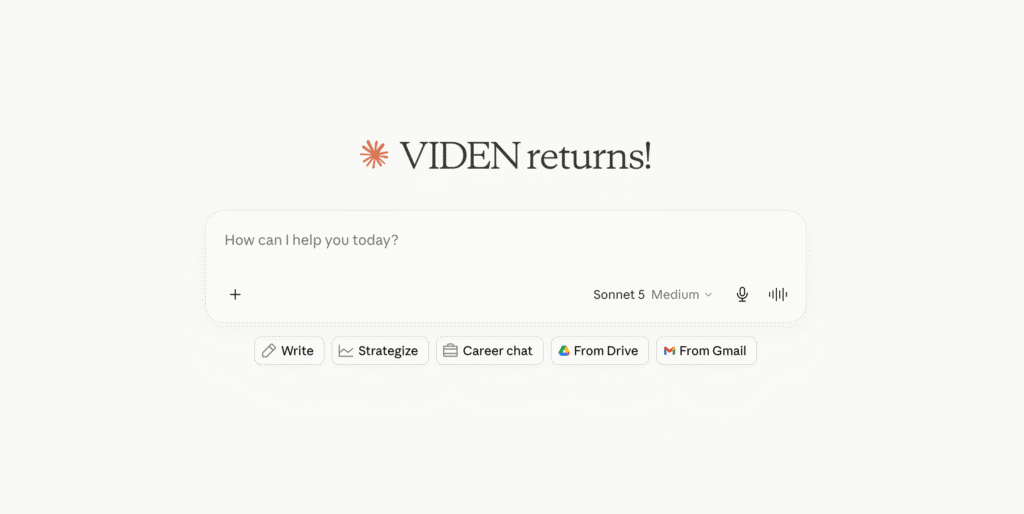
Claude supports deep thinking and structured content creation, which makes it ideal for marketers who need detailed campaign strategies and clear messaging frameworks. It produces long-form content such as brand guidelines, advertising briefs, and multi-channel campaign plans.
Key features:
- Extended context window for large documents
- Strategic campaign planning support
- Detailed audience and persona development
- Brand voice consistency tools
- High-quality long-form writing
Pros:
- Strong analytical and reasoning capabilities
- Produces polished, human-like content
- Ideal for complex marketing projects
Cons:
- No direct integration with ad platforms
- Cannot execute or optimize campaigns
2. ChatGPT
Best for: Advertising strategy and content creation
ChatGPT is a versatile AI assistant that helps marketers create ad copy, brainstorm ideas, and build marketing strategies. It works well for short-form content such as headlines, product descriptions, and social media ads.
Key features:
- Fast ad copy creation
- Campaign ideation and brainstorming
- Keyword and audience research support
- Multi-channel content creation
- Image generation capabilities (GPT-4o)
Pros:
- Highly flexible across marketing tasks
- Speeds up content production
- Easy to use for beginners and professionals
Cons:
- Requires manual refinement for best results
- Does not manage live campaigns
3. Google Ads AI
Best for: Google Ads optimization
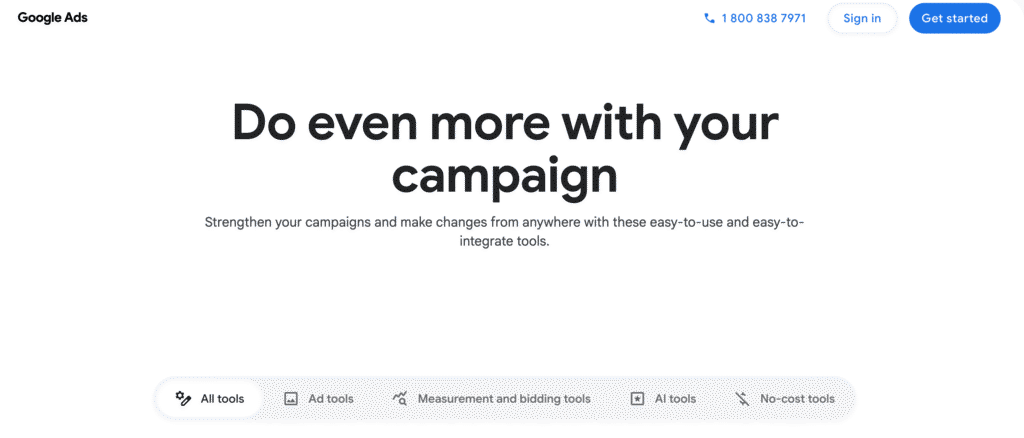
Google Ads AI uses machine learning to automate bidding, targeting, and ad delivery within the Google ecosystem. It analyzes user behavior and conversion data to optimize campaigns in real time and improve performance with minimal manual input.
Key features:
- Smart Bidding strategies
- Performance Max campaigns
- Automated asset creation
- Audience targeting signals
- Conversion tracking and optimization
Pros:
- Deep integration with Google services
- Strong automation for scaling campaigns
- Reliable performance insights
Cons:
- Limited control over automation decisions
- Restricted to Google platforms
4. Meta Advantage+
Best for: Facebook and Instagram advertising
Meta Advantage+ simplifies campaign management by automating audience targeting, creative testing, and budget allocation across Facebook and Instagram. It works well for eCommerce brands that want to scale social media advertising.
Key features:
- Automated audience discovery
- Dynamic creative optimization
- Budget distribution across placements
- Shopping campaign automation
- AI-driven performance recommendations
Pros:
- Streamlined campaign setup
- Continuous optimization without manual input
- Strong performance for retail brands
Cons:
- Limited transparency into AI decisions
- Only works within Meta platforms
5. AdCreative.ai
Best for: AI-generated ad creatives
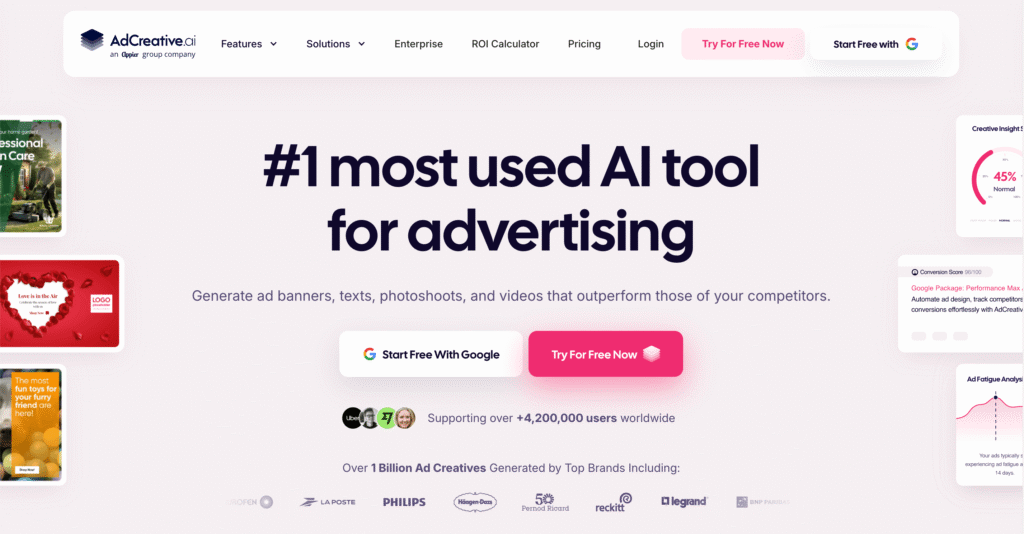
AdCreative.ai focuses on high-converting visual ads and copy variations. It uses data-driven insights to create creatives optimized for engagement and conversion across multiple platforms.
Key features:
- Automated banner and ad design
- AI-generated headlines and text
- Creative performance scoring
- Brand asset integration
- Multi-platform export options
Pros:
- Rapid creation of multiple ad variations
- Improves A/B testing efficiency
- Designed for conversion-focused ads
Cons:
- Limited campaign management features
- Advanced plans can be costly
6. Albert.ai
Best for: Enterprise campaign automation
Albert.ai is an autonomous marketing platform that manages digital advertising campaigns across channels. It analyzes performance data and adjusts targeting, bidding, and creative strategies without human input.
Key features:
- Fully automated campaign execution
- Cross-channel optimization
- Real-time budget allocation
- Audience segmentation and targeting
- Advanced performance analytics
Pros:
- Reduces manual campaign work
- Scales well for large businesses
- Integrates multiple advertising channels
Cons:
- Expensive for small businesses
- Requires onboarding and setup time
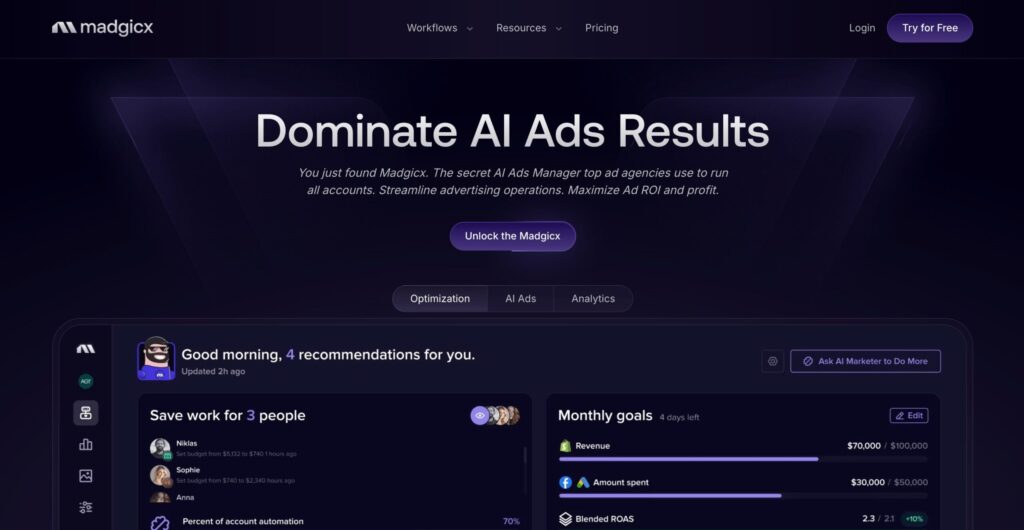
7. Madgicx
Best for: AI optimization for Meta Ads
Madgicx is a specialized tool that improves Facebook and Instagram ad performance. It combines automation with analytics to help marketers optimize budgets, audiences, and creatives based on real-time data.
Key features:
- AI-driven budget allocation
- Audience segmentation and targeting insights
- Creative performance analysis
- Automated bidding strategies
- Detailed reporting dashboards
Pros:
- Tailored for eCommerce advertisers
- Strong data-driven insights
- Improves campaign efficiency
Cons:
- Can be complex for beginners
- Focused mainly on Meta platforms
8. Pencil
Best for: AI video advertising
Pencil creates video and image ads with AI and predicts which creatives will perform best. It suits brands that rely on visual storytelling.
Key features:
- AI-generated video ads
- Image and creative production
- Predictive performance scoring
- Brand customization tools
- Team collaboration features
Pros:
- Speeds up video ad production
- Helps identify high-performing creatives
- Supports multiple ad formats
Cons:
- Limited campaign management capabilities
- Focuses mainly on creative production
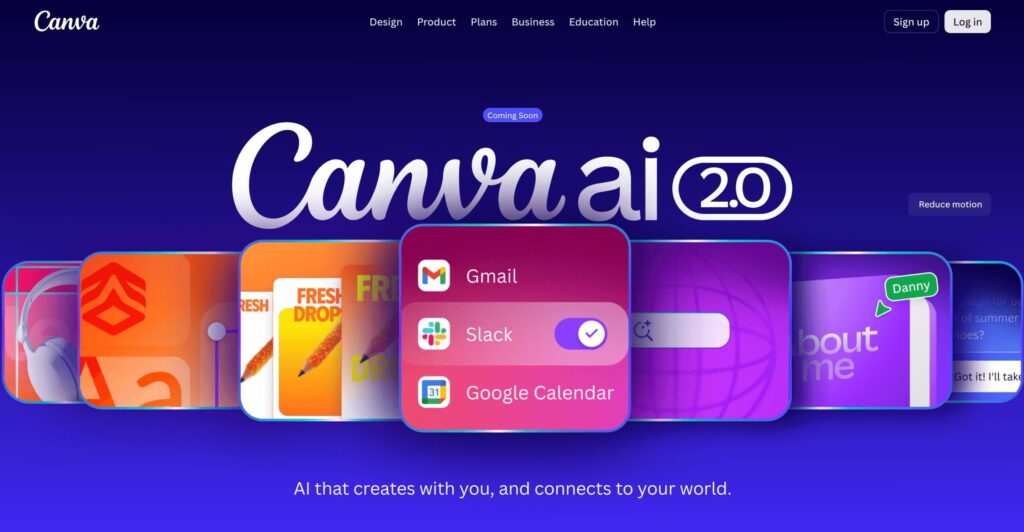
9. Canva Magic Studio
Best for: AI-powered advertising design
Canva Magic Studio offers an easy platform for creating professional advertising visuals with AI support. It suits small businesses and teams without dedicated design resources.
Key features:
- AI image and graphic creation
- Magic Design for automated layouts
- Magic Write for text creation
- Background removal tools
- Brand Kit for consistency
Pros:
- Beginner-friendly interface
- Affordable pricing options
- Extensive template library
Cons:
- Not built for campaign optimization
- Limited analytics capabilities
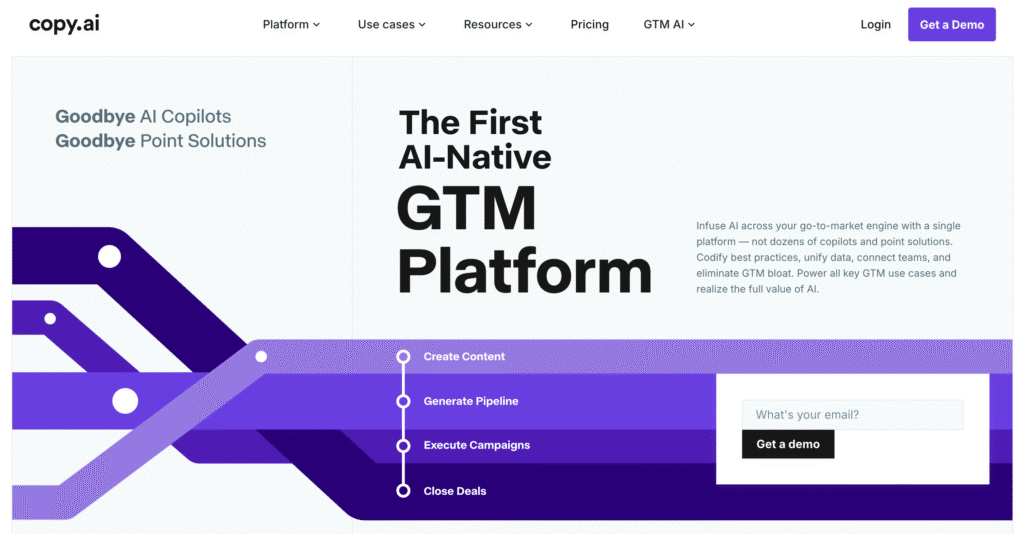
10. Copy.ai
Best for: Marketing copy generation
Copy.ai focuses on marketing copy at scale. It helps businesses create consistent messaging across ads, emails, and product pages and supports workflow automation for content production.
Key features:
- AI-powered copywriting tools
- Marketing workflow automation
- Brand voice customization
- Pre-built content templates
- Collaboration features for teams
Pros:
- Speeds up content creation
- Easy to use for teams
- Supports multiple marketing formats
Cons:
- Requires editing for tone consistency
- Does not manage advertising campaigns
Common Challenges and Limitations
While AI advertising tools can significantly improve efficiency and campaign performance, they are not a complete replacement for human expertise. Businesses should understand their limitations to set realistic expectations and choose the right tools for their needs.
Limited Human Creativity
AI can generate ad copy, images, and campaign ideas quickly, but it may struggle to capture brand personality, cultural nuances, or emotional storytelling. Human review is still essential to ensure content aligns with your brand voice and resonates with your audience.
Data Quality Matters
AI systems rely on high-quality data to deliver accurate recommendations. Incomplete, outdated, or inaccurate customer data can reduce targeting accuracy and lead to less effective advertising campaigns.
Learning Curve
Many AI advertising platforms include advanced features that require time to learn. Teams may need training to fully understand automation settings, reporting dashboards, and optimization tools.
Integration Challenges
Not every AI tool integrates seamlessly with existing eCommerce platforms, CRMs, or advertising channels. Before adopting a solution, verify that it supports your current marketing technology stack.
Ongoing Costs
Many AI advertising tools operate on subscription-based pricing, and costs can increase as your business scales. Consider both the initial investment and long-term expenses when comparing platforms.
Privacy and Compliance
AI-powered advertising often relies on customer data for personalization and optimization. Businesses must ensure their marketing practices comply with regulations such as GDPR, CCPA, and other applicable privacy laws while maintaining transparency with customers.
Final Thoughts
AI advertising tools transform how eCommerce and retail businesses run digital campaigns. They automate tasks, improve targeting, and boost performance through data-driven insights.
However, success depends on more than just technology. You need to choose the right tools and combine them with a strong strategy and creative expertise.
If you want to grow with AI-driven advertising, VIDEN Growth can help. Our team combines advanced AI with proven marketing expertise to deliver high-performing campaigns tailored to your goals.
Frequently Asked Questions
Some of the best AI advertising tools include ChatGPT, Claude, Google Ads AI, Meta Advantage+, AdCreative.ai, Albert.ai, Madgicx, Pencil, Canva Magic Studio, and Copy.ai. The right choice depends on your business goals and advertising channels.
Identify the task you want to improve, such as content creation or campaign optimization, then choose a tool that fits your goals. Start with a small campaign, measure results, and optimize over time.
No. AI automates repetitive tasks and provides insights, but marketers are still needed to develop strategy, ensure brand consistency, and make creative decisions.
Yes. Many AI tools offer affordable plans and help small businesses automate advertising, create content faster, and improve campaign performance without large marketing teams.