
With more than 900 million weekly active users, ChatGPT offers eCommerce brands a major new ad channel. But limited benchmarks and unfamiliar campaign formats leave many marketers unsure whether to test it. Questions about pricing, targeting, tracking, and campaign setup add to the uncertainty.
This guide explains how ChatGPT Ads work, what they cost, and how to launch your first campaign. It also examines where the platform could fit within your broader eCommerce marketing services strategy.
What Are ChatGPT Ads and How Do They Work?
ChatGPT Ads are sponsored placements that appear separately from ChatGPT’s organic answers. They connect advertisers with users whose conversations show interest in a relevant product, service, or solution.
Unlike search ads, which often depend on specific keywords, ChatGPT Ads use the broader context of a conversation. The system may consider the user’s intent, ad copy, landing page content, context hints, and product feed data.
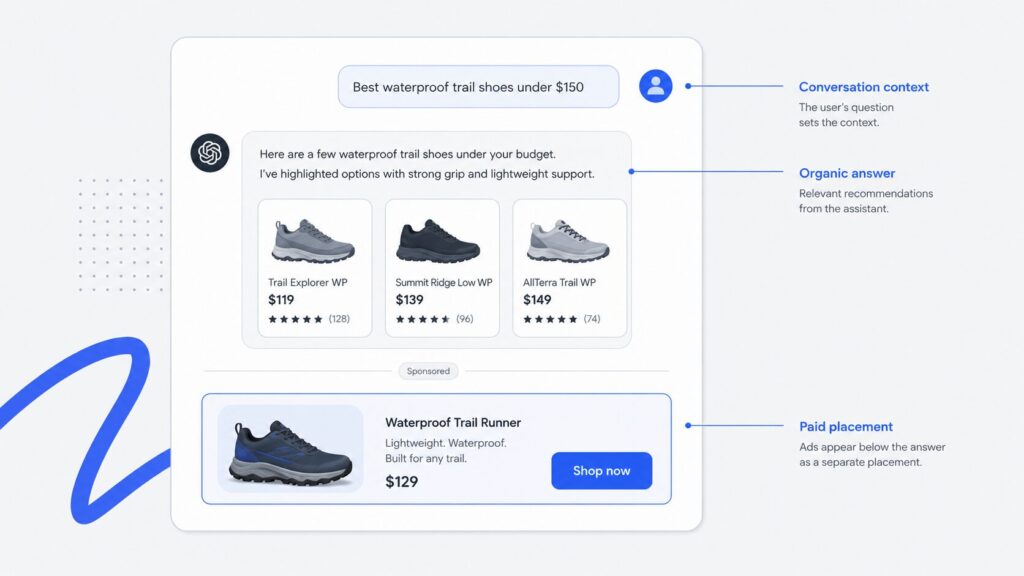
Key features of ChatGPT Ads include:
- clear “Sponsored” labels;
- placement outside the organic ChatGPT response;
- CPC and CPM campaigns managed through Ads Manager;
- matching based on conversation context rather than exact keywords;
- support for individual offers and product feed campaigns;
- conversion tracking and external analytics through UTM parameters;
- no paid influence over ChatGPT’s answers or organic product results.
For example, a user may ask ChatGPT to recommend waterproof trail shoes under $150. A relevant retailer’s ad could appear after the response if its products, ad copy, and landing page match that request.
Where Are ChatGPT Ads Available?
ChatGPT Ads Manager is not yet available worldwide. As of July 2026, advertisers can access it in Australia, Canada, Japan, South Korea, New Zealand, the United Kingdom, and the United States. OpenAI states that country availability may change as the beta expands.
Availability can affect both account creation and the locations you can target. Before planning a campaign, check the latest Ads Manager country list and confirm that your business and intended market are supported. Brands outside the available countries can register their interest with OpenAI and wait for access to expand.
How Much Do ChatGPT Ads Cost in 2026?
There is no fixed price for a ChatGPT ad. The final cost depends on your bid, campaign objective, competition, and how well the ad matches the conversation.
ChatGPT Ads currently uses two payment models:
- CPC, or cost per click: You pay when someone clicks the ad.
- CPM, or cost per thousand impressions: You pay when the ad receives 1,000 views.
For click campaigns, OpenAI recommends a starting maximum bid of $3–$5 per click. This is the highest amount you are willing to pay, not necessarily the final price. The platform uses an auction, and the winning advertiser may pay less.
What budget do you need?
The minimum daily campaign budget is currently $25. For a first eCommerce test, a practical budget would be:
| Test Period | Daily Budget | Total Budget |
| 14 days | $25 | $350 |
| 14 days | $50 | $700 |
This range should give the campaign enough time to collect early performance data. It is a suggested testing budget, not an official OpenAI benchmark.
During the test, focus on four numbers:
- cost per click;
- click-through rate;
- cost per purchase;
- return on ad spend.
ChatGPT Ads is still a new channel, so established industry benchmarks are limited. Compare the results with your Google and Meta campaigns before you raise the budget.
What Budget Do You Need to Test ChatGPT Ads?
Choose your daily ad spend to see what a 30-day test could cost.
$50 per day
A smaller exploratory budget. Check current platform requirements and campaign feasibility before launching.
Turn This Budget Into a Launch Plan ↗$100 per day
A larger exploratory budget for testing campaign messaging and monitoring early results.
Turn This Budget Into a Launch Plan ↗$250 per day
A higher-spend scenario with more room to explore campaign variations, subject to platform availability and requirements.
Turn This Budget Into a Launch Plan ↗Estimates reflect media spend only and exclude management fees. These amounts are illustrative, not official minimum budgets or performance forecasts.
How to Launch ChatGPT Ads for eCommerce
ChatGPT Ads campaigns are created in OpenAI Ads Manager Beta. Before launch, complete your advertiser profile, add billing details, verify the account, and prepare the campaign assets.
1. Choose the Campaign Objective
Choose the CPM objective for reach and visibility, or the Clicks objective for website traffic. Then set the target locations, campaign dates, and budget.
2. Create Ad Groups Around Customer Intent
Organize each ad group around one product category or shopping need. A footwear retailer, for example, could create separate ad groups for waterproof trail shoes, running shoes under $150, and wide-fit hiking shoes. Add context hints that describe the conversations where each offer is relevant, but remember that they guide the matching system rather than work as exact-match keywords.
3. Use a Product Feed for Larger Catalogs
Retailers with large or frequently updated catalogs can upload a product feed and organize campaigns around selected product groups. Keep product titles, descriptions, prices, availability, images, and landing pages accurate because this data helps the platform match products with relevant conversations.
4. Build the Ads
Each ad should include a clear title, short description, image, and relevant destination URL. Explain what the product is, who it suits, and why the shopper should consider it. Direct users to a specific product or collection page instead of the store homepage, and create several ad versions to test different products, benefits, and customer needs.
5. Add Conversion Tracking
Set up the OpenAI Pixel, the Conversions API, or both. For most eCommerce campaigns, the primary conversion should be a completed purchase. Add UTM parameters to the landing-page URLs so you can compare ChatGPT Ads performance with data from your analytics platform.
6. Submit and Launch the Campaign
Review the settings, submit the ads for approval, and confirm that the campaign status changes to active. Once delivery begins, track impressions, clicks, spend, average CPC, conversions, revenue, and return on ad spend. Keep the first campaign simple so you can identify which products, messages, and customer needs lead to sales.
ChatGPT Ads vs. Google and Meta Ads
ChatGPT Ads reach shoppers in a different context, so they should be evaluated alongside Google and Meta rather than as a direct replacement.
How ChatGPT Ads Differ From Google Ads
Google Ads captures demand through search queries. ChatGPT Ads can reach users earlier, while they describe a problem, compare options, or ask for product advice. This gives advertisers more context, but the platform currently offers fewer historical benchmarks and optimization signals.
How ChatGPT Ads Differ From Meta Ads
Meta Ads rely heavily on audience data, interests, and creative engagement. ChatGPT Ads focus more on the content and intent of the current conversation. As a result, clear product information and relevant landing pages may matter more than broad lifestyle targeting.
Where ChatGPT Ads Fit in the Marketing Mix
ChatGPT Ads should complement established channels rather than replace them. Google can capture high-intent searches, Meta can create demand, and ChatGPT can reach shoppers during research and comparison. The best approach is to test the platform alongside existing campaigns and compare customer acquisition cost, conversion rate, and ROAS.
Why ChatGPT Ads Are Worth Exploring for eCommerce
ChatGPT Ads may be particularly valuable for eCommerce because they can reach shoppers while they are actively researching products, comparing options, and narrowing down a purchase. Key advantages include:
- Detailed shopping intent: Conversations can reveal a shopper’s preferred price, product features, use case, and other purchase criteria.
- Product discovery: Ads can introduce relevant products while users are asking for recommendations or exploring possible solutions.
- Support for product feeds: Retailers can use catalog data such as product titles, prices, images, availability, and landing-page URLs.
- Relevance for large catalogs: Product-feed campaigns can help match individual items with specific customer needs.
- Stronger landing-page alignment: Brands can direct shoppers to the most relevant product or collection page rather than a general homepage.
- Access to research-stage customers: The channel can reach shoppers before they enter a product name or purchase-focused query into a search engine.
- New performance insights: Testing ChatGPT Ads can show which products, customer needs, and conversational contexts generate qualified traffic and sales.
How to Measure ChatGPT Ads Performance
A ChatGPT Ads campaign should be measured from the first impression to the final purchase. Start with reach and clicks, then check whether those visits lead to sales at an acceptable cost.
| Stage | Metric | What It Shows | What to Check |
| Visibility | Impressions | How often the ads appear | Low impressions may point to limited budget, narrow relevance, or campaign issues |
| Engagement | CTR | How often users click after seeing the ad | A low CTR may mean the offer or creative does not match the conversation |
| Traffic Cost | Average CPC | How much each website visit costs | Compare CPC with Google, Meta, and your target acquisition cost |
| Conversion | Conversion Rate | How many visitors complete a purchase | Check product relevance, page speed, pricing, and checkout experience |
| Acquisition | Cost per Purchase | How much ad spend produces one order | Compare the result with your margin and target CAC |
| Revenue | ROAS | How much revenue each advertising dollar generates | Use ROAS to decide whether to pause, improve, or scale the campaign |
How to Read the Results
Do not evaluate one metric in isolation. A high CTR may look positive, but it has little value when visitors do not buy. Likewise, a higher CPC can still be profitable when those clicks produce larger or more frequent orders.
Compare performance across campaigns, ad groups, products, and creatives. Keep UTM parameters on each landing page and connect purchase tracking before launch so you can compare ChatGPT Ads data with your analytics and eCommerce platform. Increase the budget only after the campaign produces consistent sales at an acceptable acquisition cost.
Common ChatGPT Ads Mistakes to Avoid
ChatGPT Ads rely on conversation relevance, clear product information, and accurate measurement. The following mistakes can waste budget and make campaign results harder to interpret.
Using Broad Ad Groups
Do not place unrelated products or customer needs in the same ad group. Keep each group focused on one category, use case, or intent so the system has a clear idea of which conversations the ads should match.
Treating Context Hints Like Keywords
Context hints are broad signals, not exact-match search terms. Write descriptive phrases around customer needs and shopping situations instead of filling the field with isolated keywords.
Writing Generic Ad Copy
Vague claims such as “premium quality” give users little reason to click. State what the product is, who it is for, and which problem it solves. Each creative variation should present a distinct angle rather than repeat the same message.
Sending Every Click to the Homepage
The landing page should match the product and promise in the ad. Send users to a relevant product, collection, or content page so they can act without searching the store again.
Using Outdated Product Data
Incorrect prices, unavailable items, and weak product descriptions can break the connection between the conversation, ad, and store. Review feed titles, images, availability, and destination URLs before launch.
Launching Without Conversion Tracking
Clicks alone cannot show whether a campaign generates profitable orders. Set up the OpenAI Pixel, Conversions API, or both, and add static UTM parameters before the campaign starts.
Scaling Before Results Are Stable
Early clicks or a high CTR do not prove that a campaign is profitable. Wait for purchase data, compare cost per order and ROAS with other channels, and increase the budget only after results remain consistent. Conversion data may take 24–48 hours to appear in Ads Manager.
ChatGPT Ads Limitations in 2026
ChatGPT Ads is still a developing platform, so eCommerce brands should account for several limitations before they commit a large budget.
| Limitation | What It Means for Advertisers | How to Respond |
| Limited performance benchmarks | Reliable industry averages for CPC, conversion rate, CAC, and ROAS are still scarce | Compare results with your own Google and Meta campaigns |
| Fewer campaign controls | Targeting, bidding, reporting, and optimization options are less mature than those on established platforms | Start with a simple campaign structure and test one variable at a time |
| Limited placement visibility | Advertisers may not see the exact conversations that triggered each ad | Group campaigns by clear customer needs and review performance at the ad-group level |
| Dependence on product data | Weak titles, outdated prices, or incorrect availability can reduce relevance | Keep product feeds and landing pages accurate |
| Limited historical data | The platform has less conversion history for automated optimization | Allow enough time and budget to collect useful data before making decisions |
| Beta-stage changes | Pricing, formats, access, and reporting tools may change as the platform develops | Review campaign settings regularly and avoid relying on ChatGPT as your only acquisition channel |
Final Thoughts
ChatGPT Ads gives eCommerce brands a new way to reach shoppers while they research products, compare options, and make purchase decisions. Since the platform is still developing, start with a controlled test, accurate product data, focused ad groups, and reliable conversion tracking.
Compare the results with Google and Meta, then scale only when the campaign meets your CAC or ROAS targets. Not sure whether ChatGPT Ads fits your store? Reach out to VIDEN Growth for help with channel assessment, campaign structure, test budgets, conversion tracking, and performance analysis. Our team can help you launch with a clear plan and decide whether the results justify further investment.
FAQ
Create an account in OpenAI Ads Manager Beta, complete advertiser verification, and add a payment method. Choose a Clicks or Views objective, set the budget and locations, create intent-focused ad groups, and add your ad copy, image, and landing page. Set up conversion tracking before you submit the campaign for review.
ChatGPT Ads supports CPC and CPM pricing. With CPC, you pay for each valid click; with CPM, you pay per 1,000 impressions. OpenAI recommends an initial maximum CPC bid of $3–$5, while the current minimum daily campaign budget is $25. Actual costs depend on competition, bids, campaign relevance, and delivery.
Ads appear separately from ChatGPT’s organic response and include a clear sponsored label. A placement may contain the advertiser’s name, ad copy, an image, and a link to the relevant landing page.
Yes. Advertisers can track purchases and other conversion events through the OpenAI Pixel, the Conversions API, or both. UTM parameters also help connect ChatGPT Ads traffic with Google Analytics and eCommerce reporting platforms.
No. Ads operate separately from the chat model, and advertisers cannot change, rank, or shape ChatGPT’s responses. Sponsored placements are clearly labeled and do not represent an endorsement from OpenAI.