
The global beauty and personal care market is forecast to reach $683 billion by 2028, and brands continue to invest more in digital advertising to win customers. As competition on Meta grows, the cost of customer acquisition increases, and brands must work harder to stand out.
Many beauty brands struggle to generate consistent results from Meta Ads. Strong creatives lose momentum, broad targeting wastes budget, and scaling often leads to higher costs instead of higher profits. Without a clear strategy, even high-quality products can fail to deliver a positive return on ad spend.
This guide explains how to build a profitable Meta Ads strategy for beauty brands. You’ll learn how to create high-performing creatives, reach the right audiences, and scale campaigns without sacrificing efficiency.
Why Meta Ads Are Effective for Beauty Brands
Meta Ads give beauty brands the tools to attract new customers, build trust, and drive repeat purchases on platforms where consumers already spend a significant amount of time actively discovering new products and searching for solutions to their needs. Combined with strong creatives and the right campaign strategy, Meta helps brands reach high-intent audiences and optimize performance as campaigns scale.
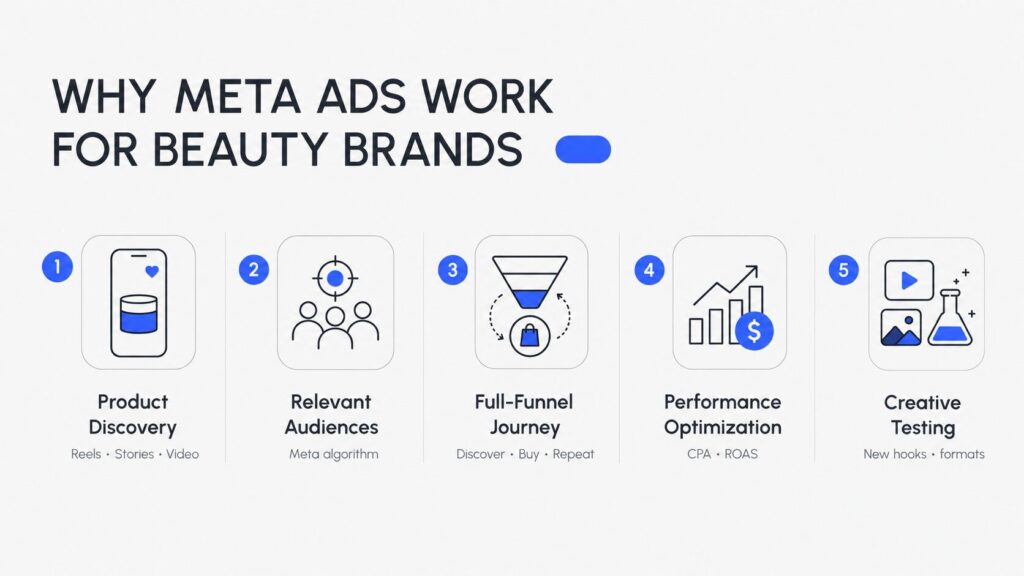
Meta Ads are particularly effective because they enable brands to:
- Showcase products through visually engaging formats, including videos: Reels, carousels, and Stories.
- Leverage Meta’s advanced advertising algorithm to identify and reach the audiences most likely to engage and convert.
- Guide shoppers through the entire customer journey, from product discovery to purchase and retention.
- Optimize campaigns automatically based on conversion data to improve ROAS and reduce customer acquisition costs.
- Continuously test new creatives and messaging to combat ad fatigue and maintain performance.
Creative Strategy That Sells Beauty Products
Creative is the biggest performance driver in today’s Meta ecosystem. The algorithm uses creative signals to find people most likely to convert, so brands need to test a wide range of messages, formats, and creators.
Maintain Creative Diversity
Combine polished assets with UGC, lifestyle images, casual phone content, text-only and “ugly” ads, product demonstrations, GIFs, AI animations, and behind-the-scenes videos. Vary both the visual style and the message rather than creating minor versions of the same concept.
Use Creators and Partnership Ads
Work with creators who represent different ages, beauty concerns, skin or hair types, and lifestyles. Partnership ads extend the reach of their content through their accounts, combining creator credibility with Meta’s paid distribution.
Tailor Creative to Personas and Problems
Create separate hooks, benefits, and proof points for different customer personas. Use the problem-agitation-solution framework to introduce a familiar frustration, make its impact clear, and show how the product solves it.
Build Trust Through People and Results
Use UGC, testimonials, founder ads, and employee-generated content to show the people behind the brand. Support these stories with before-and-after visuals, routines, texture shots, application videos, and wear tests that demonstrate results.
Match Creative to Awareness Levels
Use Eugene Schwartz’s five stages of awareness to adapt the message:
- Unaware: Lead with a relatable situation.
- Problem aware: Focus on the frustration.
- Solution aware: Introduce the solution category.
- Product aware: Use demonstrations and proof.
- Most aware: Reinforce the decision with reviews, offers, and urgency.
Testing across personas, creators, formats, and awareness stages helps prevent fatigue and maintain performance as campaigns scale.
How to Test Meta Ad Creatives
Effective creative testing means comparing meaningfully different concepts, evaluating them against the right goals, and using Meta’s delivery signals to decide what to scale, refresh, or replace.
- Test distinct creative concepts. Compare different personas, angles, hooks, formats, and visual styles rather than making minor changes to the same ad. Creatives that look too similar may be treated by Meta as the same asset, limiting delivery and reducing the value of the test.
- Group ads by persona or angle. Structure testing campaigns around the audience, problem, or message being tested, not visual similarity. A visually diverse group gives Meta more options to deliver and increases the chance that multiple ads receive spend.
- Use funnel-specific KPIs. Top-of-funnel ads may be evaluated through reach, engagement, video views, and traffic quality, while bottom-of-funnel ads should be judged by purchases, CPA, and ROAS. Do not apply the same primary KPI across every stage.
- Track spend allocation alongside performance. When Meta consistently directs budget toward a creative, it usually signals strong audience response. An ad receiving little spend may be too similar to other assets or may lack positive early signals.
- Pause clearly weak ads early. Creatives need enough time and budget to generate useful data, but you do not always need to wait for conversions. Ads with unusually poor engagement, click-through rates, or traffic costs can often be stopped sooner.
- Test different formats and executions. Compare static images, carousels, and video, with varied executions such as UGC, demonstrations, testimonials, lifestyle content, founder videos, and text-led ads. Focus on creative differences rather than placements such as Reels or Stories.
- Refresh what already works. Do not allocate all resources to finding new personas or angles. Extend winning concepts with new creators, hooks, settings, messages, and visual treatments.
- Align testing with business goals. A brand that has exhausted solution-aware demand may need creative that reaches less-aware audiences. A new brand starting from zero may benefit more from product- and solution-aware ads than from broad market education.
How to Target the Right Audience
For most beauty brands, interest-based and demographic targeting does not work and can limit Meta’s ability to find buyers. Use these restrictions only when they are absolutely crucial to the product. Lookalike audiences also do not provide a meaningful advantage, so the focus should be on broad targeting and accurate audience observation.
| Audience Type | Recommended Use | How to Approach It |
| Broad Audience | Customer acquisition | Give Meta enough room to optimize delivery using creative and conversion signals |
| Interest and Demographic Targeting | Only when important | Apply restrictions only when age, gender, location, or another factor is critical to product eligibility or relevance |
| Lookalike Audience | Not recommended | Do not rely on lookalikes for prospecting or scaling |
| Existing Customer Lists | Audience observation | Keep customer and subscriber lists accurate and use them to track how much spend reaches existing buyers |
| Website and Engagement Audiences | Audience observation | Monitor whether campaigns are acquiring new customers or repeatedly reaching warm audiences |
Be meticulous with customer lists, website audiences, and engagement audiences. Use them as observation groups rather than targeting tools so you can check at any point whether your budget is driving new customer acquisition or cannibalizing existing demand.
Recommended Meta Campaign Structure
A streamlined campaign structure gives Meta more data and flexibility while making it easier to test creatives and scale products. For most beauty brands, separate retargeting and retention campaigns are no longer necessary because Meta can automatically deliver ads across the customer journey.
- Testing campaign: Group new creatives by the persona or messaging angle being tested. Each group should include visually diverse ads so Meta has enough options to distribute, spend and identify strong concepts.
- Evergreen campaign: Move proven creatives into an evergreen setup designed to scale. Brands with several SKUs may use separate evergreen campaigns or ad sets to give each product enough budget and room to grow.
- Creative-led retargeting and retention: Use creative to address different stages of the funnel instead of building separate campaigns. Educational or problem-focused ads may reach new audiences, while testimonials, product proof, and offer-led ads are more likely to reach warmer users and existing customers.
- Minimal setup restrictions: Keep targeting, placements, and other campaign controls as broad as possible unless a restriction is essential. This gives Meta more freedom to match each creative with the right audience.
- Campaign budget optimization: CBO can distribute budget effectively across ad sets and products, but it should be tested against your current setup rather than treated as a universal rule.
The purpose of this structure is to create a reliable testing engine for new creative and a clear path for scaling winning ads across different SKUs.
How to Scale Meta Ads Without Increasing CPA
Scaling Meta Ads is not simply a matter of increasing the budget. The goal is to generate more conversions while keeping CPA stable by protecting what already works, maintaining a strong creative pipeline, and using Meta’s delivery signals to guide decisions.
Scale Proven Campaigns
Increase spend only after a campaign has generated consistent conversion volume, CPA, and ROAS. Make sure the results are sustained over time rather than driven by a short-term spike.
Increase Budgets Gradually
Raise budgets in controlled increments and give Meta time to adjust after each change. Avoid making several major edits at once, since this can disrupt delivery and make it harder to understand what affected performance.
Do Not Touch What Is Working
If a campaign or creative continues to scale efficiently, avoid unnecessary changes. Strong performers do not need constant optimization, and editing them can interrupt stable delivery.
Refresh the Ad Mix
Regularly introduce fresh creatives into existing high-spend campaigns. New hooks, messages, creators, formats, and visual styles help reduce fatigue, maintain delivery, and bring CPA back down as older ads lose momentum.
Monitor Performance and Delivery Signals
Track CPA and ROAS alongside spend allocation to see which ads Meta is willing to scale. For video creatives, review thumbstop ratio, hook rate, hold rate, and average play time to identify where attention drops and which concepts deserve further investment.
Real Results from Beauty Brand Campaigns
The strategies in this guide reflect our experience managing paid media campaigns for beauty and skincare brands.
| Brand | Challenge | Results |
| ILNP | Improve customer acquisition and advertising efficiency in a highly competitive market. | 21% YoY growth in Meta Ads sales, a 26% increase in conversion value, and a 30% lower CPC after restructuring campaigns and introducing continuous creative testing. |
| Le Mieux Skincare | Scale paid media while maintaining profitable growth across digital channels. | 16.2% YoY growth in net sales through a full-funnel paid media strategy, ongoing campaign optimization, and close performance tracking. |
| Timeless Skin Care | Grow revenue and new customer acquisition while reducing high acquisition costs and improving advertising efficiency. | 25% revenue growth and a 45% increase in new customer acquisition. Meta Ads also delivered a 50.2% increase in CTR, a 38.7% increase in 7-day click ROAS, and a 26.44% lower CPA. |
These case studies show that long-term Meta Ads success doesn’t come from a single tactic. It comes from a clear strategy, regular creative testing, smart audience optimisation, and disciplined scaling based on performance data.
Explore our beauty brand case studies to learn how these strategies translate into measurable business results.
Key Metrics Every Beauty Brand Should Track
ROAS and CPA show the final outcome, but they do not explain why an ad is working or where performance is breaking down. Track delivery, attention, engagement, and conversion metrics together to understand campaign health and identify what to improve.
| Metric | Why It Matters | What to Watch For |
| Spend Allocation | Shows which ads Meta is willing to prioritize based on the signals it receives. | A creative that receives little spend may have weak early signals or may be too similar to other ads in the campaign. |
| CPA (Cost per Acquisition) | Measures how much it costs to acquire a customer. | A rising CPA may point to creative fatigue, lower conversion rates, or increased competition. |
| ROAS (Return on Ad Spend) | Shows how much revenue ads generate for every dollar spent. | Evaluate ROAS against profit margins, customer lifetime value, and business goals rather than using it alone. |
| CTR (Click-Through Rate) | Indicates whether the creative and call to action generate interest. | A declining CTR may signal creative fatigue, weak messaging, or a mismatch between the ad and audience. |
| Conversion Rate | Measures how many visitors purchase after clicking an ad. | Low conversion rates may indicate issues with traffic quality, the offer, product page, or checkout experience. |
| Thumbstop Ratio | Shows whether the opening seconds of a video stop users from scrolling. | A low ratio suggests that the first frame, visual, text overlay, or opening action needs to be stronger. |
| Hook Rate | Measures how effectively impressions turn into initial video views. | Compare hooks across creatives to identify which openings capture attention and attract relevant viewers. |
| Hold Rate | Shows whether viewers continue watching after the initial hook. | A strong hook with a low hold rate usually means the body of the video loses attention or moves too slowly. |
| Average Play Time | Shows how many seconds viewers watch on average. | Place the main benefit, offer, and product proof before the typical drop-off point. |
| Frequency | Shows how often the same users see an ad. | High frequency combined with falling CTR or rising CPA may indicate fatigue. |
| CPM (Cost per 1,000 Impressions) | Measures the cost of reaching users through Meta’s auction. | Rising CPM may reflect competition, limited delivery opportunities, or weak creative signals. |
No single metric explains performance on its own. Review conversion results alongside spend allocation and creative engagement metrics to understand which ads Meta wants to deliver, where viewers lose interest, and what should be refreshed or scaled.
Common Meta Ads Mistakes Beauty Brands Make
Even strong campaigns can underperform when creative testing is too limited, scaling decisions are too slow, or performance is judged without considering the full customer journey.
Relying on Too Few Creative Inputs
Do not depend on one winning ad, persona, messaging angle, funnel stage, or format. Build a diverse mix unless the business goal clearly requires focus on a specific audience or awareness level.
Testing Too Little or Too Infrequently
Low creative volume limits Meta’s ability to find new winners and replace fatigued ads. Test new concepts consistently and refresh high-spend campaigns before performance declines.
Overcomplicating Audience Targeting
Narrow interest and demographic targeting can restrict delivery without improving results. Keep targeting broad unless a specific restriction is essential, and let the creative communicate with the intended customer.
Scaling Too Quickly or Too Slowly
Large budget increases can disrupt performance, but waiting too long can also waste a short-lived opportunity. Scale proven campaigns while they are working, and move especially quickly during sales and promotional periods.
Ignoring Seasonality and Promotional Opportunities
Plan creative around seasonal needs, gifting occasions, launches, and sales. These moments change customer intent, so the message, offer, and production schedule should be ready before demand peaks.
Relying Too Heavily on the Offer
A strong discount may generate immediate sales, but it cannot replace brand building or creative diversity. Balance offer-led ads with product education, lifestyle content, customer proof, and distinctive brand creative.
Treating Funnel Stages as Separate Campaigns
Use different creatives to address each stage instead of relying on separate prospecting, retargeting, and retention campaigns. Meta can deliver educational content to colder audiences and product proof, testimonials, or offers to warmer customers.
Focusing Only on ROAS
Review ROAS alongside CPA, conversion rate, customer lifetime value, profit margins, and overall business growth. Top-of-funnel creative may have weaker primary KPI results while still feeding the rest of the funnel and improving the bottom line.
FAQ
Yes. Meta Ads are one of the most effective advertising channels for beauty brands because they combine visual formats with advanced algorithms and automated optimization. Brands can use video, static ads, UGC, and creator content to reach customers across different stages of the buying journey.
Strong beauty campaigns use a diverse mix of UGC, founder ads, before-and-after transformations, tutorials, product demonstrations, and customer testimonials. These formats build trust, show real results, and help shoppers understand how the product could fit into their routines.
Beauty brands should introduce new creative regularly and monitor metrics such as spend allocation, CTR, CPA, thumbstop ratio, hook rate, and hold rate for signs of fatigue. The right frequency depends on campaign spend and performance, so brands should refresh high-spend campaigns as soon as existing assets begin to lose momentum.
Many brands rely on one or two creative formats, personas, or messaging angles for too long. A stronger approach is to maintain creative diversity across formats, visual styles, creators, funnel stages, and messages while continuously testing new concepts and refreshing what already works.
Ready to Scale Your Beauty Brand?
Building profitable Meta Ads campaigns takes more than increasing your budget. Success comes from the right mix of creative testing, audience strategy, campaign optimisation, and continuous improvement.
If you want to grow your beauty brand with expert support, VIDEN Growth can help. Get in touch to see how our Meta Ads specialists can build and scale campaigns that deliver measurable results.