Global online retail sales are projected to reach $6.8 trillion by 2028, as eCommerce becomes a larger part of how people discover, compare, and buy products. At the same time, AI is becoming a larger part of eCommerce, with the market expected to reach $17.33 billion by 2028 as brands apply it across personalization, inventory, customer support, and marketing.
But as the market expands and AI tools become more common, many eCommerce brands still struggle to understand where AI creates real business value. With so many solutions that promise automation, personalization, and higher sales, it can be difficult to separate practical applications from hype.
In this article, we’ll break down the key benefits of AI in eCommerce, explore its most useful applications, and show how brands use AI to improve customer experience, increase efficiency, and grow revenue.
What Does AI Do In eCommerce?
AI in eCommerce automates tasks, personalizes shopping experiences, and helps brands make faster decisions with data. It replaces slow, manual processes with systems that can respond to customer behavior, inventory changes, and campaign performance in real time. Here is what changes when brands apply it.
| Without AI | With AI |
| Product recommendations based on category rules | Recommendations based on individual browsing and purchase behavior |
| Customer segments updated manually, weekly or monthly | Segments updated automatically as behavior changes in real time |
| Support teams answering every inquiry by hand | Common questions handled automatically, complex ones routed to humans |
| Pricing decisions made from spreadsheets after the fact | Pricing adjusted dynamically based on demand, inventory, and competition |
| Demand forecasts based on last year’s sales | Forecasts built from real-time sales trends, seasonality, and promotions |
| Ad budgets allocated based on gut feel or past performance | Budgets shifted automatically toward best-performing audiences and channels |
Why AI Matters for eCommerce Brands
AI matters because eCommerce brands now operate in a more competitive, data-heavy, and margin-sensitive market. Customers expect faster and more relevant experiences, while brands need to manage more channels, rising acquisition costs, and increasingly complex operations.
Here are the main pressures AI helps address.
1. Higher Customer Expectations
Customers expect online stores to feel relevant from the first interaction. They want accurate search results, useful product recommendations, fast answers, and offers that match their needs. AI helps brands use customer behavior and purchase history to make the shopping journey more personal and convenient.
2. More Data Across Platforms
eCommerce brands collect data from websites, ad platforms, CRM systems, email tools, product catalogs, support platforms, and transactions. This data is often spread across different systems, which makes it hard to see the full customer journey. AI helps connect these data points and turn them into clearer insights about customers, products, campaigns, and retention.
3. Rising Competition
Online brands compete across search engines, social media, marketplaces, email, and paid advertising platforms. As more brands target the same audiences, it becomes harder to attract customers efficiently. AI helps teams understand which audiences, products, channels, and messages are most likely to drive profitable growth.
4. Pressure On Margins
Revenue growth does not always mean stronger profitability. Stockouts, overstock, wasted ad spend, inefficient support, poor pricing decisions, and high return rates can all reduce margins. AI helps brands spot these issues earlier through demand forecasts, campaign analysis, pricing insights, and support automation.
5. Need For Faster Decisions
eCommerce conditions can change quickly. Demand can shift after a campaign launch, a product can sell out faster than expected, or ad performance can drop within days. AI helps brands monitor changes faster, surface important trends, and make decisions based on current data.
Top AI Applications In eCommerce
The top AI applications in eCommerce include product recommendations, AI-powered search, customer support automation, demand forecasting, dynamic pricing, marketing automation, advertising optimization, content generation, visual search, and fraud detection.
The most valuable are the ones tied to a clear business goal, such as higher conversion rates, lower support volume, better retention, or stronger return on ad spend.
| AI Application | How Brands Use It | Business Value |
| Product Recommendations | Suggest relevant products based on behavior, purchase history, and product relationships. | Better product discovery, higher average order value, stronger retention. |
| AI-Powered Search | Understand customer intent, synonyms, vague queries, and conversational searches. | Faster product discovery and less friction in the shopping journey. |
| Customer Support Automation | Answer FAQs, share order updates, process simple requests, and route complex tickets. | Faster support and lower manual workload. |
| Demand Forecasting | Analyze sales trends, seasonality, promotions, and customer behavior. | Fewer stockouts, less overstock, better inventory planning. |
| Marketing Automation | Personalize email, SMS, ads, and lifecycle campaigns. | Better retention and more efficient customer communication. |
| Advertising Optimization | Analyze campaign data, refine audience signals, test creatives, and adjust budgets. | Better ROAS and more informed media decisions. |
| Product Content Generation | Create product descriptions, ad copy, email content, and landing page variants. | Faster content production and more creative testing. |
| Visual Search | Analyze product images, tag catalog items, and recommend visually similar products. | Better catalog management and product discovery. |
| Fraud Detection | Flag suspicious transactions, unusual payment patterns, and risky behavior. | Lower financial risk and stronger checkout security. |
Different Types of AI Used in eCommerce
The main types of AI used in eCommerce are machine learning, natural language processing, predictive analytics, generative AI, computer vision, recommendation systems, and AI automation, each serving a different function across marketing, operations, and customer experience.
Here is what each one does and where eCommerce brands typically apply it.
- Machine Learning: Machine learning helps AI systems learn from customer, product, sales, and marketing data. In eCommerce, it is often used for product recommendations, customer segmentation, demand forecasts, pricing decisions, and fraud detection.
- Natural Language Processing: Natural language processing helps AI understand and respond to human language. eCommerce brands use it in chatbots, customer support automation, product search, review analysis, and voice assistants.
- Predictive Analytics: Predictive analytics uses historical and real-time data to estimate future outcomes. It can help brands forecast demand, predict customer lifetime value, identify churn risk, and understand which products or campaigns are likely to perform well.
- Generative AI: Generative AI creates new content based on prompts, patterns, and existing information. In eCommerce, it can support product descriptions, ad copy, email content, customer service replies, creative testing, and personalized messaging.
- Computer Vision: Computer vision allows AI to analyze images and videos. It is useful for visual search, product tagging, image quality checks, virtual try-on tools, and product recommendations based on visual similarity.
- Recommendation Systems: Recommendation systems suggest relevant products, offers, or content to shoppers. They use data such as browsing behavior, purchase history, product relationships, and customer segments to improve product discovery and increase average order value.
- AI Automation: AI automation combines artificial intelligence with automated workflows. It can support abandoned cart follow-ups, support ticket routing, inventory alerts, fraud checks, reporting, and campaign optimization.
Popular AI Tools for eCommerce Brands
The most widely used AI tools for eCommerce brands include Shopify Magic, Klaviyo AI, Gorgias, Algolia, Dynamic Yield, Salesforce Commerce AI, and Google Performance Max, each built for a different part of the commerce stack.
The right choice depends on the specific problem a brand needs to solve, whether that is customer support, product discovery, marketing automation, or paid advertising.
| Tool | Best for | Main Use Case |
| Shopify Magic and Sidekick | Shopify merchants | Store tasks, content, images, insights, and customer replies |
| Klaviyo AI | Retention marketing | Email, SMS, lifecycle campaigns, segmentation, and personalization |
| Gorgias AI Agent | Customer support | FAQs, order tracking, returns, support automation, and shopping assistance |
| Algolia | Product discovery | AI search, recommendations, merchandising, and visual search |
| Dynamic Yield | Personalization | Website personalization, A/B testing, offers, and product recommendations |
| Salesforce Commerce AI | Enterprise commerce | Guided shopping, merchandising, product recommendations, and CRM-connected insights |
| Google AI Max for Search | Paid advertising | AI-supported bidding, budget optimization, audiences, and creative combinations |
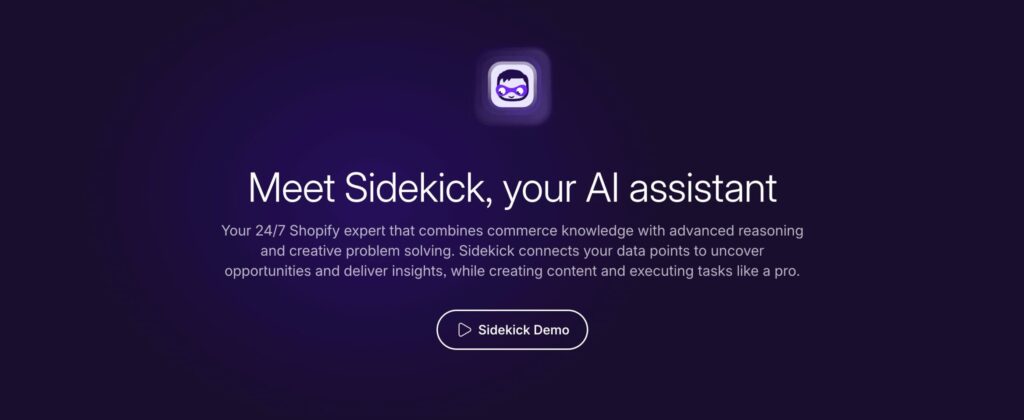
1. Shopify Magic and Sidekick
Shopify Magic and Sidekick are built for Shopify merchants that want AI support directly inside their store environment. These tools can help teams create content, edit product visuals, answer customer questions, and access store insights without moving between multiple platforms.
Key points:
- Creates product descriptions, emails, and customer-facing copy.
- Supports product image edits and visual improvements.
- Helps merchants understand store performance and customer behavior.
- Reduces manual work for content, product pages, and support replies.
- Works best for brands already using Shopify as their eCommerce platform.
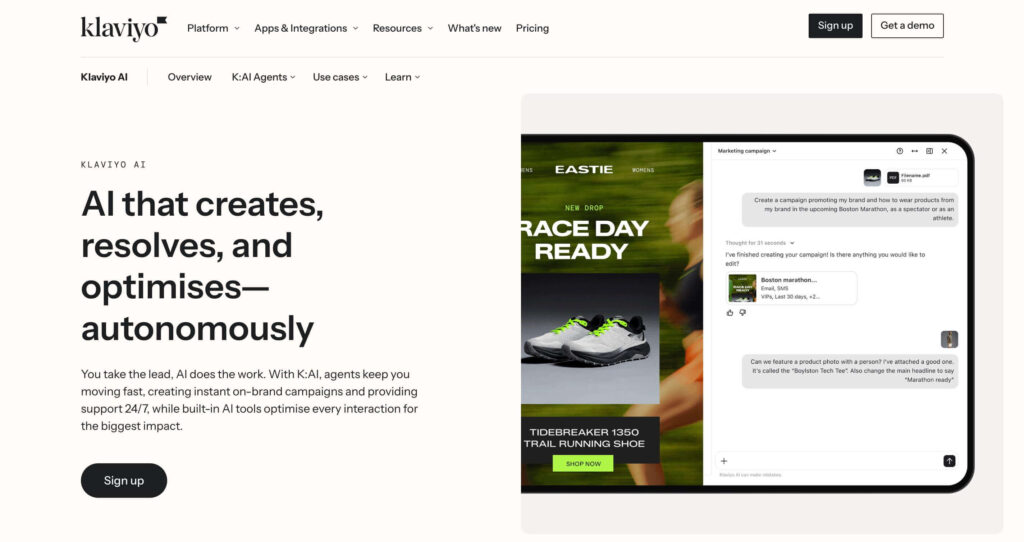
2. Klaviyo AI
Klaviyo AI helps eCommerce brands improve marketing automation, customer retention, and lifecycle communication. It is especially useful for brands that use email and SMS to drive repeat purchases, recover abandoned carts, and build stronger customer relationships.
Key points:
- Supports email and SMS campaign creation.
- Helps personalize messages based on customer behavior and purchase history.
- Improves audience segmentation and lifecycle marketing.
- Can support abandoned cart flows, win-back campaigns, and retention programs.
- Works best for brands that rely heavily on owned marketing channels.
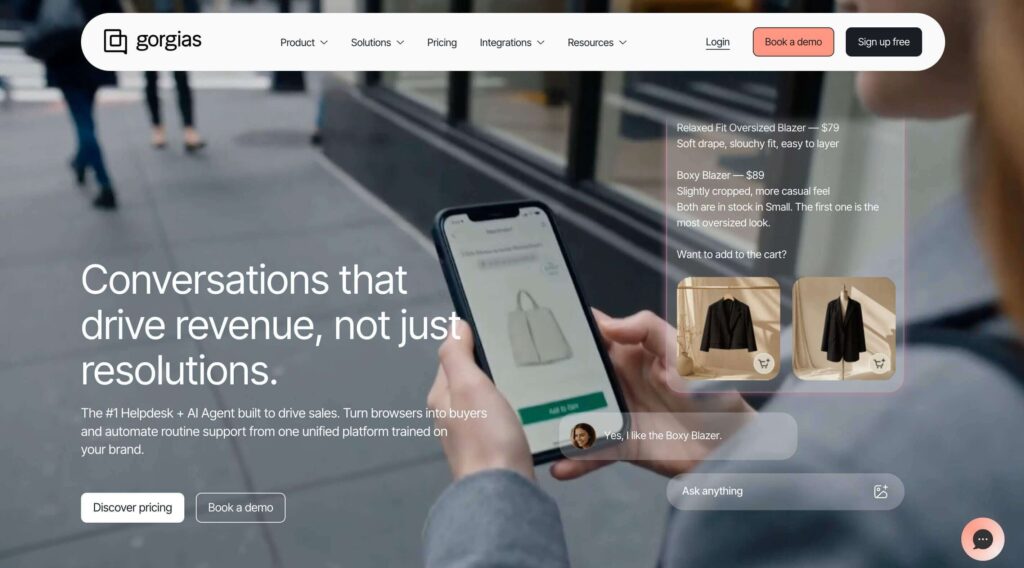
3. Gorgias AI Agent
Gorgias AI Agent is designed for customer support in eCommerce. It helps brands answer common customer questions faster, automate repetitive support tasks, and reduce the workload for customer service teams.
Key points:
- Answers FAQs about shipping, returns, refunds, and order status.
- Helps manage high support volume without adding more manual work.
- Can support pre-purchase and post-purchase customer questions.
- Improves response speed and support consistency.
- Works best for brands with frequent customer inquiries.
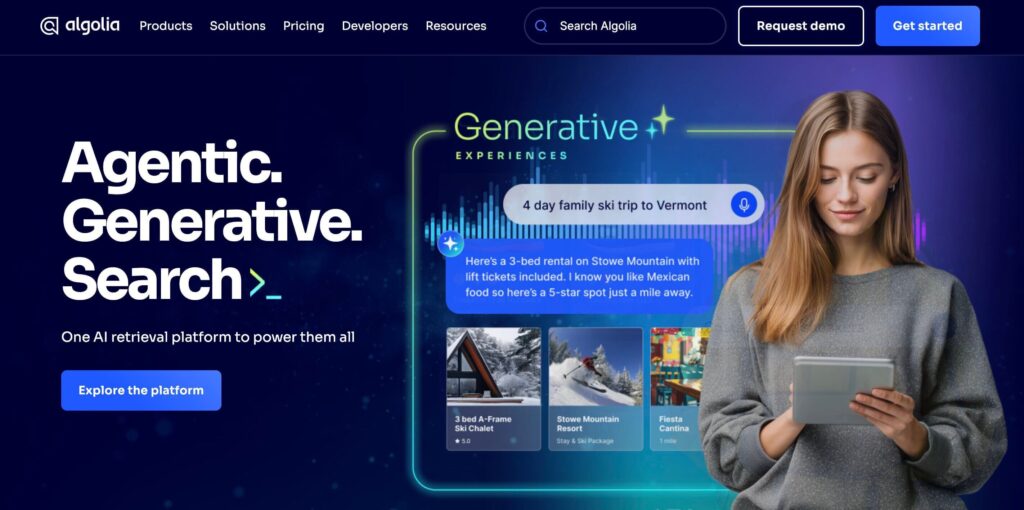
4. Algolia
Algolia helps eCommerce brands improve site search, product discovery, and merchandising. It is especially useful for stores with large product catalogs, where shoppers need fast and accurate search results to find the right products.
Key points:
- Improves on-site search relevance.
- Helps shoppers find products faster.
- Supports product recommendations and merchandising rules.
- Works well for brands with large or complex catalogs.
- Can reduce search friction and support higher conversion rates.
5. Dynamic Yield
Dynamic Yield is a personalization platform for brands that want to tailor website experiences, recommendations, offers, and content to different customers. It is best suited for businesses with enough traffic and data to support advanced testing and personalization.

Key points:
- Personalizes product recommendations, offers, and website content.
- Supports A/B testing and customer experience experiments.
- Helps brands adapt the shopping journey to different audience segments.
- Works well for brands with mature eCommerce operations.
- Best suited for mid-market and enterprise businesses.
6. Salesforce Commerce AI
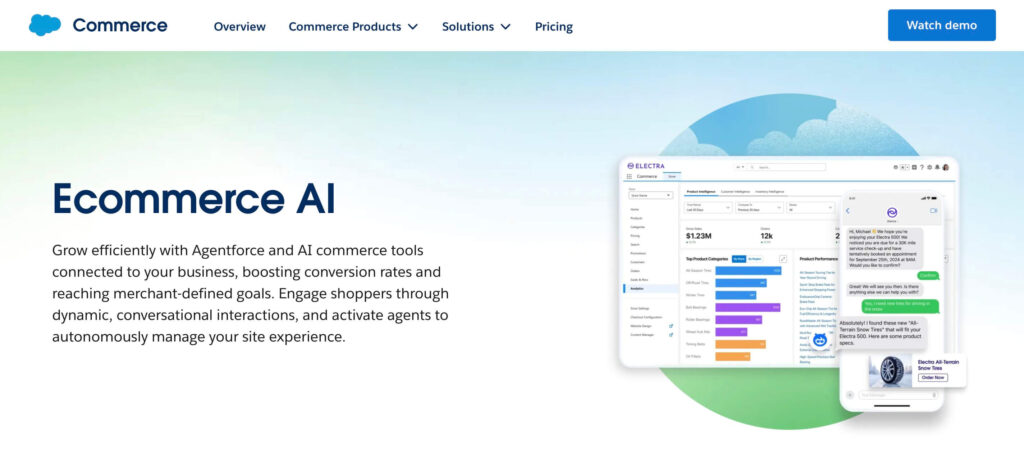
Salesforce Commerce AI supports larger commerce teams that already use Salesforce tools. It connects AI with customer data, merchandising, product recommendations, promotions, and commerce operations.
Key points:
- Supports product recommendations and guided shopping.
- Helps with merchandising, promotions, and product content.
- Connects commerce activity with broader CRM data.
- Useful for complex customer journeys and larger teams.
- Works best for enterprise brands that already use Salesforce Commerce Cloud.
7. Google AI Max for Search
Google AI Max for Search is an AI-powered feature suite within Google Ads Search campaigns. It helps eCommerce brands expand search reach, match to more relevant queries, and improve ad relevance using Google AI across targeting, creative, and landing page optimization.

Key points:
- Uses AI-powered search term matching to reach relevant queries beyond existing keywords.
- Supports asset optimization and text customization to tailor ad messaging in real time.
- Can help identify new high-performing search demand while keeping campaigns within the Search environment.
- Works best with Smart Bidding, strong conversion tracking, and well-structured landing pages.
- Gives advertisers more control than fully automated campaign types, while still adding AI-driven expansion.
How eCommerce Brands Can Start Using AI
The best way for eCommerce brands to start with AI is to pick one specific business problem, choose a single tool built to solve it, and measure results before expanding. A focused use case and reliable data matter more than the number of tools deployed.
- Define The Business Goal: Start with a specific outcome, such as better conversion rates, fewer support tickets, stronger retention, more accurate inventory forecasts, or improved ROAS.
- Audit Your Data: Review customer, product, sales, marketing, and inventory data before you choose a tool. AI performs better when data is accurate, connected, and current.
- Choose One Use Case First: Start with a practical area such as AI search, email personalization, support automation, product recommendations, or ad optimization.
- Keep Human Oversight: AI can suggest actions and automate workflows, but teams still need to review outputs, protect brand voice, and check business context.
- Measure Business Impact: Track metrics such as conversion rate, average order value, ROAS, customer lifetime value, support response time, retention rate, and stock availability.
- Scale Gradually: Once the first use case proves value, expand AI into adjacent areas such as merchandising, pricing, creative testing, or customer segmentation.
Key Challenges of Using AI in eCommerce
The key challenges of using AI in eCommerce include poor data quality, complex system integration, high implementation costs, lack of internal expertise, privacy risks, overdependence on automation, and unclear business goals. Each of these can limit how much value a brand gets from AI, even when the underlying tools are strong.
1. Poor Data Quality
AI depends on accurate, complete, and well-structured data. If customer, product, inventory, or marketing data is outdated, fragmented, or inconsistent across platforms, AI tools may produce weak recommendations, inaccurate forecasts, or misleading insights.
2. Complex Integration
Many eCommerce brands use several systems at once, including store platforms, CRMs, ad accounts, analytics tools, inventory software, and customer support platforms. Integrating AI into this ecosystem can be difficult when data sources are disconnected or systems do not communicate well with each other.
3. High Implementation Costs
AI adoption can require investment in software, data infrastructure, technical setup, and team training. For smaller brands, the challenge is to choose solutions that match their budget and provide clear business value instead of adding unnecessary complexity.
4. Lack of Internal Expertise
AI tools are most effective when teams know how to interpret their outputs and apply them correctly. Without the right skills, eCommerce businesses may collect AI-generated insights but struggle to turn them into better marketing, operations, or customer experience decisions.
5. Privacy and Compliance Risks
AI often uses customer data to personalize experiences, forecast behavior, and improve targeting. Brands need to make sure this data is collected, stored, and used responsibly, especially when they operate across markets with different privacy regulations.
6. Overdependence on Automation
AI can support decisions, but it should not replace human judgment completely. If brands rely too heavily on automated recommendations, they may miss strategic context, brand positioning, creative nuance, or customer expectations that AI cannot fully understand.
7. Unclear Business Goals
Some brands adopt AI because it feels like a trend, not because they have a specific use case. Without clear goals, such as improving conversion rates, reducing stockouts, increasing retention, or optimizing ad spend, it becomes difficult to measure whether AI is creating real value.
Future of AI in eCommerce
The future of AI in eCommerce is connected systems that link data from advertising, search, support, and purchase history to make every customer interaction more relevant. Rather than isolated tools, brands will use AI as a continuous layer across acquisition, product discovery, retention, and planning.
Here are the main ways AI is likely to shape eCommerce in the next few years:
- Connected Customer Journeys: AI will help brands connect data from websites, ads, email, support, and purchase history. This can make each interaction feel more relevant, from the first visit to the next purchase.
- Smarter Shopping Assistants: AI assistants will help shoppers compare products, ask questions, and choose the right item faster. For brands, this means less friction and more chances to turn visitors into customers.
- Faster Content Production: AI will help teams create product descriptions, ads, emails, and landing page versions faster. This gives eCommerce brands more space to test ideas across different audiences and channels.
- More Accurate Forecasts: AI will support demand forecasts, inventory planning, and product performance analysis. This can help brands avoid stock issues, plan promotions better, and make smarter operational decisions.
- Better Growth Strategy: As AI becomes more accessible, the real advantage will come from clean data, clear goals, and a strategy that connects AI tools with real business growth.
Final Thoughts
AI is becoming a practical growth tool for eCommerce brands. It can help businesses personalize shopping experiences, improve product discovery, automate support, forecast demand, optimize advertising, and make faster decisions across the full customer journey.
The brands that benefit most from AI will not be the ones that adopt the most tools. They will be the ones that connect AI to clear goals, reliable data, and measurable business outcomes. For eCommerce teams, the real opportunity is to use AI not as a shortcut, but as a smarter way to understand customers, improve operations, and grow with more precision.
For brands that want to connect AI insights with paid media, analytics, and growth strategy, VIDEN Growth helps eCommerce businesses turn data into practical advertising decisions. Reach out today to find the right AI opportunities for your eCommerce brand and turn them into campaigns that drive measurable growth!
FAQ
Start with one clear goal, such as better product search, faster support, stronger email personalization, or improved ad performance. Then choose one AI tool, test it on a key metric, and scale only after it proves value.
AI will become more connected across the full customer journey. Brands will use it for smarter shopping assistants, better personalization, faster content creation, more accurate forecasts, and stronger growth decisions.
AI in eCommerce is the use of artificial intelligence to analyze data, automate tasks, and personalize shopping experiences. It helps brands improve search, recommendations, support, marketing, inventory, and fraud detection.